Inflation rate records marginal increase
By Henry Sinyangwe
Fri 31 Aug. 2012, 14:20 CAT
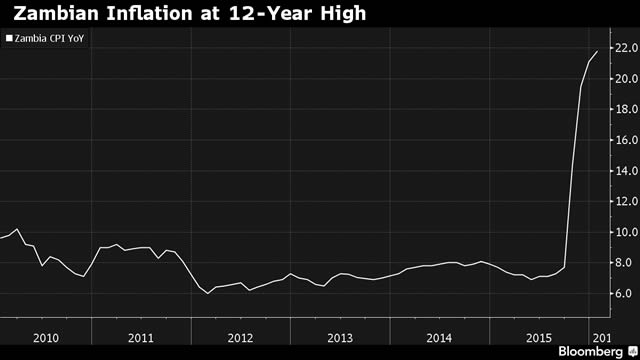
ZAMBIA'S inflation rate for August has recorded a marginal increase, up from 6.2 per cent seen in July to 6.4 per cent this month.
During a monthly briefing to announce the country's inflation rate yesterday, Central Statistical Office (CSO) director of census and statistics John Kalumbi attributed the rise in inflation to increases in food prices.
"Between July and August 2012, the annual rate of inflation increased for food and non-alcoholic beverages; furnishings, household equipment and routine house maintenance, health, education, and miscellaneous goods and services, while the annual rate of inflation decreased for alcoholic beverages and tobacco; clothing and footwear; housing, water, electricity, gas, and other fuels; recreation and culture; and restaurant and hotel," he said.
Kalumbi said the annual food inflation rate was recorded at 7.3 percent in August 2012 compared to 6.3 percent in July 2012 while the annual non-food inflation rate was recorded at 5.5 percent in August from 6.0 in July.
"This implies that there was a 1.0 percentage point increase in annual food while that of non food items decreased by 0.5 percentage points over the
previous month," he said. "A comparison of retail prices between July 2012 and August 2012 shows that the national average price of a 25 kilogrammes bag of breakfast mealie meal increased by 2.4 per cent from K42,074 to K43,119. The national average price of a 25 kilogramme bag of roller mealie meal increased by 2.0 per cent from K31,464 to K32,121..."
Meanwhile, Kalumbi said the enumeration phase of the economic census began this month and the CSO staff are currently in the field collecting data from about 12,000 enterprises and establishments for the financial year 2010.
Kalumbi also said Zambia has recorded a trade surplus valued at K383.2 billion in July 2012, the highest since January from K163.0 billion recorded in June 2012.
Labels: CSO, INFLATION
Read more...
CSOs protest over 'unfair share' from mines
By Gift Chanda
Sat 23 June 2012, 13:22 CAT
A CROSS section of civil society groups interested in the mining industry on Thursday demonstrated and pelted organisers of Zambia's second international mining conference in Lusaka over what they described as "unfair share" from the natural resources.
The civil society groups, who were also attending a parallel mining conference in Lusaka dubbed: 'Mining in Zambia; who benefits?' denounced investors in the mining industry over lack of attention on communities they operate in.
The interest groups, who were drawn from Europe and the Southern African Development Community (SADC) including Zambia, accused investors of ripping Zambia off its mineral resource and leaving very little benefits for the locals.
Carrying placards, some which read; "We want our money! Where is it?", "Let's have a fair share of the profits", the CSOs convened at the new Government Complex where the international mining and energy conference was taking place and denounced the investors operating in Zambia, Africa's top copper producer.
They regretted that despite Zambia being endowed with mineral resources, more than 60 per cent of its 13 million populace live under the poverty datum line.
The interest group also reminded the government on its pre-election promise to re-introduce the controversial windfall tax.
According to a communiqué, the civil society groups demanded among others, increased benefits from the mining sector.
They demanded that the government revises the current mining tax regime in a way that would enable it collect commensurate royalties on mineral sales, gross production and tax on mining profits.
"The existing tax regimes in the mining sector are inadequate and undermine the socio-economic benefits for Zambians from the extractive industries. This has resonated from lack of transparency and accountability across the whole mining value-chain, coupled with narrow scope and levels of the fiscal arrangement," read part of the communiqué.
"The multinational corporations continue to undermine and manipulate national laws, standards and regulations, resulting in the worsening of the situation on the ground. In addition, the Zambia Revenue Authority's limited capacity to monitor, collect and enforce tax laws has worsened the status quo."
They demanded that mines be owned 51 per cent by indigenous people to have a fair share of the profits realised from mining activities.
Presently, most mines are majority owned by foreign companies who are allowed to externalise 100 per cent profits under the Zambian laws.
"As owners of the natural wealth, we demand that Zambians be given the first priority in owning, prospecting and awarding of contracts," they stated.
"It is also imperative that Zambia's government monitors and controls capital flight."
Additionally, they asked the government for a clear, transparent and consistent contract awarding mechanism ostensibly resulting in maximising the benefits of extractive industries while promoting ethical investments.
The interest groups noted with concern that the Zambian government lacked the political will and capacity to negotiate contracts that should result in maximising the benefits of mining, while promoting ethical investment.
"Realising that mining contracts are shrouded with secrecy, we demand that there must be a clear, publicly disclosed and consistent contracting mechanism," they stated.
"The government must review all current extractive contracts based on best environmental management and social standards. Parliament should be actively be involved in the ratification of mining contracts to protect the interest of the Zambian people and enhance accountability."
Participants for the parallel indaba that was held under the auspices of the three Church mother bodies namely: Council of Churches in Zambia, Evangelical Fellowship of Zambia and Zambia Episcopal Conference, were drawn from South Africa, Malawi, Zimbabwe, Mozambique, and United Kingdom.
Labels: CSO, DEVELOPMENT AGREEMENTS, MINING, TAXATION, WINDFALL TAX
Read more...
Chikwanka backs CSO's calls for windfall tax
By Gift Chanda
Sat 26 May 2012, 12:43 CAT
ANY democratically-elected government that sets conditions to only favour investors betrays its people, says Council of Churches social and economic justice programme officer Nsama Chikwanka.
Commenting on calls by civil society organisations to reintroduce windfall tax in the mining sector, Chikwanka, a development expert, said there is need for the government to stop protecting the interests of investors at the expense of the people that ushered them into power.
Civil society organisations have stepped up calls for the reintroduction of the windfall tax on mines as the PF government prepares its first wholly developed national budget.
He said it is important for the government to establish that a country can only develop from the prudent utilisation of its various resources, both human and natural.
In this case, Chikwanka said the principal beneficiaries of Zambia's natural resource endowments should be Zambians and anything short of that is short-changing the owners of the land.
"It is betrayal of its people for a democratically-elected government to set conditions that support or favour the investors," Chikwanka said in an emailed response to a query.
"The story about ensuring that the goose is not killed should be viewed also from the point that we should not let the geese become so powerful as to start dictating how many eggs it should contribute. Any investment should not disadvantage locals."
He pointed out that at the moment, apart from the huge holes, traffic jams, finished roads, increased pollution and interim media statements, there is nothing to show for the boom in the mining sector.
"A walk to the Copperbelt tells the whole story; all roads leading to all major mining towns are in deplorable state and are death traps," Chikwanka said.
"The government needs to start governing instead of protecting the interests of investors."
He called on the government to involve everyone in the country's development agenda.
"Our greatest challenge is the unclear tax system for the country. Firstly, there are so many taxes in the sector, some of which are conflicting, and are responsible for the misunderstanding that is created when companies start giving their total contribution to the treasury. We need tax policies and systems that can be understood by all; at the moment, there is a system that works for and is only understood by government and sector investors. The current discourse is confusing to the common Zambian who is left to wonder how tax experts have failed to agree on this concept," Chikwanka said.
"So the challenge is for Zambia to harmonise its tax system that will be clear for all because at the moment, only the government and investors claim to understand what taxes are collected and how much.
"Any tax information that is coming from civil society and other interest groups is disputed."
He further noted that the other compounding factor to the whole tax debate in the mining sector is the secrecy surrounding the mining agreements.
International Monetary Fund country representative Perry Perone recently revealed that the Zambian government had agreed to conduct a comprehensive review of the mining tax regime.
"Until the government comes in the open to state the nature of the mining agreements, Zambians are justified in their speculations and cannot be blamed for concluding there is corruption and abuse of authority in the whole process," said Chikwanka.
Labels: CSO, DEVELOPMENT AGREEMENTS, IMF, MINING, TAXATION, WINDFALL TAX
Read more...
CSOs want judges appointed by Judicial Service Commission
By Roy Habaalu
Tue 08 May 2012, 14:00 CAT
A CONSORTIUM of civil society organisations has recommended that the appointment of judges be done by the Judicial Service Commission and not the President.
And the civil society constitution coalition says the draft constitution was progressive and needed to be defended. Meanwhile the Zambia Episcopal Conference says it will only give a position on the recently-released first draft constitution after its executive meeting this week.
During a briefing, civil society constitution coalition chairperson Fr Leonard Chiti said under the draft constitution, the Judicial Service Commission would be more involved in the appointments of Supreme Court judges which was not provided for in the current Constitution.
"Alternatively, we recommend that the nomination as proposed in Article 183 should only apply to the Chief Justice so that the rest of the Judges as listed in the same Article should be appointed by the Judicial Service Commission and not the President. This will foster separation of powers between the executive and the judiciary," said Fr Chiti.
He said the inclusion of the Bill of Rights, reduction of presidential powers and enshrining of the election date in the constitution was satisfactory.
Fr Chiti said the several progressive clauses in the draft constitution would help in developing and strengthening the country's democratic systems if implemented.
He said they were happy with the provision for presidential petitions as well as the transition period before the assumption of office of the newly elected president.
Fr Chiti said the 14 days which the draft constitution had provided for in Article 1039(2) (a) was enough.
"We further want to recommend that in an event that the elected vice-president takes over the office of the President, the vice-president who is appointed by the new President should have the same qualifications as those of the elected president and vice-president.
With regards to separation of powers, the draft has provided in Article 120(2) that the President shall appoint ministers from persons who are not Members of Parliament. We support this position and it needs to be protected as the consultations go on. We also note that the new constitution does not provide for deputy ministers which we also feel is progressive as roles of deputy ministers have not been clear and beneficial to the country," he said.
On the election date, Fr Chiti said the draft constitution had provided for more oversights by the National Assembly on some presidential powers.
"We find it progressive.
Articles 91 and 92 94) provides for curtailing of Presidential powers by empowering National Assembly to ratify presidential appointments, however it should be strengthened by referring the final decision to the constitutional court in an event that the National Assembly does not ratify the President's nominations. Those ratifications under Article 92 (4) if the decision is not referred to the constitutional court makes the National Assembly a rubber stamp of presidential decisions," he said.
Fr Chiti said the draft constitution had adequately provided for the immunity of the President under Article 96 though Article 969(8) was not necessary as it would make it difficult if a former president's case was to be appealed further.
Fr Chiti said the draft had provided a much more strengthened Bill of Rights that needed to be protected.
He said however that Article 68 (1) and 68 (2) (a) on limitations on rights and freedoms had left room for the state to take away people's rights.
"Claw-back clauses that refer to denial of rights because of 'interests of defence, public safety, public order, public morality, or public health' should be guarded against as this can easily be used by the State to take away or deny the rights of persons especially when such exceptions provided to the State cannot be questioned by a court, tribunal or commission," he said adding "Even though some restrictions and clarifications on the extent of one's enjoyment of the right are needed, such restrictions should explicitly be subject to decisions by judicial actions. Particular rights, such as the right to life and freedom from torture and inhuman treatment should never be limited or violated in whatever circumstance."
He recommended that the clause under Article 158 be inserted empowering the constituents to pass a vote of no confidence in their member of parliament as contained in Article 189 of the Mung'omba draft constitution.
Fr Chiti said under Article 139 (2), a clause should be included to the effect that the office of a member of parliament becomes vacant if a vote of no confidence was passed.
The civil society urged President Michael Sata to immediately appoint a referendum commission.
"We further demand for a referendum date to be set. We also want to know what will go to referendum. Is it the entire draft constitution or only parts? It's important for the government to indicate this as previous attempts have failed partly because of subjecting the entire document to certain processes where even the good provisions are killed," said Fr Chiti.
ZEC president Archbishop Ignatius Chama said in an interview yesterday that immediately after the conference's executive meeting, which he will chair in Lusaka on Friday, ZEC would make its position known over contents of the first draft constitution.
"We will look at it draft constitution," Archbishop Chama said.
He said the executive meeting of ZEC was not the Bishops' plenary conference as the latter would only be held in July.
The ZEC executive conference is only attended by members of the Bishop's body's executive and apart from setting the agenda for July's Bishops' conference, it will hear reports from ZEC institutions and the regional AMECEA, among others.
And commenting on the arrival of the newly-appointed Vatican Ambassador to Zambia Apostolic Nuncio Archbishop Julio Murati, Archbishop Chama said the Apostolic Nuncio was not only a diplomat but also a representative of the Church of Rome in the country.
Archbishop Murati who arrived in the country last Friday, replaces Archbishop Nicola Girasoli, who has since been assigned to the Caribbean.
Labels: CSO, JUDICIARY
Read more...
Malumo calls on media, CSOs to take decisive action against corruption
By Lovely Kayombo
Fri 04 May 2012, 09:20 CAT
BETTER aid inflow can only come in when there is a serious fight against corruption, says Action Aid Africa advocacy coordinator Henry Malumo. In an interview, Malumo said the fight against corruption has to move from mere talk and politicking and called on civil society organisations and the media to take a more decisive step to end the vice.
He said freedom and access to information is fundamental in the attainment of the developmental goals, saying where this has happened, leaders are accountable to their citizens and services are delivered "because government budgets are responsive to the needs of its citizens and government priorities".
He said the absence of access to information leads to plunder and mismanagement of resources by leaders in government.
"A lot more needs to be done by members of the society, media and civil society in fighting corruption and hold the government accountable. In the absence of access to information, there will be plunder, mismanagement of resources," he said.
Malumo said the current government has made positive policy changes which will ultimately lead to the attainment of millennium developmental goals and urged them not to backtrack on their set objectives.
"There are areas where the PF government has made very positive policy changes that will ultimately lead to the attainment of MDG's...one of the most important thing is the fact that the MDGs are very near now, the target of 2015 is close and it requires coming up with efforts and not backtracking," he said.
Malumo said the government needs to look at eradicating poverty and hunger critically.
"Another critical area is to begin looking at MDG goal number one of halving hunger and poverty. I think there haven't been major positive gains in the area of poverty reduction first of all because the concentration has not positively diverted from commercial farmers to the small holder farmers which will provide food for consumption, the perception in the agriculture sector is that commercial farmers are producing food for consumption and I think that is not true, in fact most of them may not be producing food for eating, they are into agriculture for commercial gains and for export outside our markets," he said.
Malumo urged the government to make major investment in small holder farmers who need help.
"We haven't made major investments in small holder farmers which is a worrying factor and also categorical investment in women who need that help. We have still continued from the MMD trend where there was much of talk and less action...I am hoping that the move and decision to reduce interest rates by banks will ultimately empower small holder farmers and local producers to be able to compete and be able to export so that they are able to inject in foreign currency," he said.
Malumo also said the MMD government took the country slightly backwards because there was irresponsible contraction of debt after debt cancellation.
"We hope that the PF government will be prudent and transparent in its borrowing so that when they contract debt, it will be one that is agreeable," said Malumo.
Labels: CIVIL SOCIETY, CORRUPTION, CSO, MEDIA
Read more...
CSOs insist on 25% windfall tax
By Gift Chanda
Tue 27 Mar. 2012, 12:59 CAT
CIVIL society organisations have vowed to continue pushing for the reintroduction of 25 per cent windfall tax on base metals even if it means being called lunatics. And the Council of Churches in Zambia has condemned finance minister Alexander Chikwanda for calling those advocating the reintroduction of windfall tax on base metals as lunatics. Last week, Chikwanda described as lunatics those calling for the 25 per cent windfall tax on base metals.
"We shall never be tired to call on the government to introduce windfall tax," said Platform for Social Protection Zambia (PSPZ) research and advocacy officer, Phyllis Chikula during a press briefing on Saturday.
Chikula said there was urgent need for Zambia to reduce on donor dependence to finance its national budget, and that one way of doing that was improving domestic resource mobilisation through a proper tax system.
PSPZ is a national platform of civil society organisations advocating the development and implementation of effective policies and programmes for social protection in Zambia.
"We live in one of the richest countries in Africa amidst some of the poorest people in the world. This paradox of poverty is simply unacceptable," Chikula said.
Official data shows that poverty levels have remained persistently high in Zambia, with at least 60 per cent of the population falling below the poverty line.
Such very high poverty figures suggest a population under extreme lack of income and hence undergoing livelihood stress.
Chikula called for increased spending on social protection to reduce poverty levels.
She observed that government spending on social protection programmes had over the years been dwindling partly because the government was unable to finance such programmes using domestic resources.
She said social protection received 4.19 per cent of the budget allocation in 2008 while the allocation dropped to 2.93 in 2009.
According Chikula, the situation was even gloomy in 2010 as the allocation reduced further to 2.48 per cent of the budget and stood at 2.67 and 2.37 per cent in 2011 and 2012 respectively.
"Our concern is the 65 per cent poor people of Zambia who are continuously hardest hit by everyday challenges...we have to protect their warfare and, therefore, we have to start seeing social protection as an investment," said Chikula.
"We recommend that the government must consider as a matter of urgency to improve domestic resource mobilisation such us improved tax systems and administration, especially with regard to taxing the mines."
And Council of Churches (CCZ) general secretary Rev Suzanne Matale said they were saddened by Chikwanda's remarks against those advocating the re-introduction of windfall tax on copper.
"The Council of Churches in Zambia is one such organisation which has maintained that windfall tax was one way of ensuring that fair taxes are paid by investors in mining companies so that the proceeds could be used to develop the nation and make Zambia a better place for all but to be referred to as 'lunatics' and to dismiss the opinions of others with such strong words is unfortunate because it reduces the intelligence of others," she said.
Rev Matale said it was undemocratic for the PF to disregard with impunity people's participation in the good governance of the country.
She said it was unfortunate that Chikwanda could call windfall tax advocates lunatics when the PF came into power making everyone believe that it would reintroduce the windfall tax.
"At that time, it was our hope that they knew and they understood and fully appreciated the complexities and intricacies of the matter for them to come to that conclusion. It is unfortunate that six months down the road this campaign issue has become an issue that is only discussed by lunatics which sweeping statement may include some of the PF campaigners of windfall tax before the elections," she said.
Rev Matale called for civil language in discussing matters of national interest.
"It is our very high expectation that stakeholders will uphold the value of mutual respect for all, regardless of the differences in opinion. We should learn to agree to disagree and to move on as one people who value each other and who respect one another," said Rev Matale.
"If, as we are now told, windfall tax is a no-go area at least we expect that a fair but well-calculated tax regime will be put in place for the good of our country. Zambians know that the mineral wealth belongs to them and therefore a win-win situation is all we ask for and the investors should understand this."
Labels: CSO, PF, SUZANNE MATALE, WINDFALL TAX
Read more...
Zimbabwe’s voters roll perfect: Mudede
07/03/2012 00:00:00
by Gilbert Nyambabvu
REGISTRAR General, Tobaiwa Mudede has insisted that the country’s widely condemned voters’ roll is “perfect” and dismissed fears of possible rigging in elections likely to be held this year. Mudede told state radio Wednesday that his office was maintaining an up-to-date register with about 5, 8 million registered voters.
Critics have accused President Robert Mugabe's Zanu-PF party of manipulating the voters’ roll for political advantage and claim the list includes children and people who have long since died.
The Zimbabwe Support Network (ZESN), a civic organisation that seeks to promote democratic elections, last year reported that nearly a third of the of voters on the list used in the disputed 2008 elections were dead.
Prime Minister Morgan Tsvangirai’s MDC-T party has made a sanitised roll one of the key requirements before new elections can be held.
But Zanu PF says it has no problems with the current list and is confident of winning elections whether or not the roll is re-done.
Mudede defended the register telling state radio that new computer systems have since been put in place to detect double registration.
He has previously dismissed criticism of the presence of thousands of centenarians on the roll in a country where the average life expectancy is just 34 for women and 37 for men, according to the World Health Organisation.
"You don't want these people to attain 100 years; you don't want them to be alive?" Mudede said last year.
"The law does not say once one attains 100 years he/she should be removed. It is their right to vote unless they come to say they want to be removed. We will, however, still advise them that it is their right to vote," he said.
The Zimbabwe Election Commission (ZEC) said it would need about US$20 million to spruce up the widely-condemned roll after which constituency boundaries would be drawn up for general elections.
Meanwhile, the MDC-T said Wednesday it would step-up preparations for elections despite demanding completion of political reforms required under the GPA.
“The (party) resolved to treat the year 2012 as a watershed year and will prepare for elections whether or not these elections were going to be held this year,” the party’s national executive said after a meeting in Harare Wednesday.
“To Organising Department is working flat out to prepare the MDC structures for elections.
“However, the committee reiterated that the elections must only be held after all the conditions for a free and fair elections have been fulfilled.”
The party is resisting a push by President Mugabe for elections to be held this year claiming conditions do not exist to ensure a free and fair poll.
Mugabe says the polls are necessary to replace a coalition government he claims is no longer workable.
Labels: CSO, ZEC
Read more...
CSOs urge Africa to stop giving mines concessions
By Gift Chanda
Tue 21 Feb. 2012, 11:59 CAT
AFRICAN governments should be more responsible in
maximising benefits from mining through rigorous taxation, urges a consortium of civil society organisations. And the consortium has called on African governments to
stop giving concessions to mining companies at the expense of development of local entrepreneurs.According to submissions by
a consortium of civil society organisations from Botswana, Brazil, Canada, Democratic Republic of Congo, Ecuador, Ghana, Lesotho, Mozambique, Norway, Philippines, South Africa, Sweden, Tanzania, Zambia and Zimbabwe that met recently in South Africa on the sidelines of the Mining Indaba,
mining has not fully benefited Africans, the owners of the resources.
It observed that a lack of attention elements such as environmental degradation, deepening poverty levels, and slippages in the quality of life, and label the 2012 Mining Indaba as a "gathering of exploitative profit mongers".
The civil society accused mining companies operating in Africa of concentrating on profits at the expense of the welfare of the locals, adding that governments also focus on attracting foreign direct investment without ensuring that the investment benefits communities and national economies at large.
The consortium condemned the inability of governments to negotiate contracts that could result in maximising the benefits of mining while promoting ethical investment.
"We note with grave concern on limited capacity of tax revenue authorities to monitor, collect and enforce tax laws; legalisation of capital flight through the provision of high incentives, protection of transnational companies, tax avoidance, evasion and transfer pricing; lack of enforcement of existing legislation and in many countries mining policies are fragmented and inconsistent and are not harmonised across countries," observed the consortium in an emailed statement yesterday adding that mining was the worst polluter.
The consortium demanded a review of all current multi-national concessions based on ecological and social standards.
"Governments should be more responsible in maximising benefits from mining through rigorous taxation. They should stop giving concession to mining companies at the expense of the development of local entrepreneurs and must utilise mining tax revenues to diversify their economies," the consortium demanded.
It said transparency in the extractive industry should be improved by compelling mining companies to report their profits on a country by country basis.
Zambia was represented by the Council of Churches in Zambia (CCZ), the Centre for Trade Policy and Development (CTPD), Evangelical Fellowship of Zambia (EFZ), Caritas Zambia and the Norwegian Church Aid (NCA).
Labels: CIVIL SOCIETY, CSO, MINING, TAX EVASION, WINDFALL TAX
Read more...
CSOs seek more transparency on use of public resources
By Gift Chanda
Wed 14 Sep. 2011, 13:59 CAT
THREE Civil Society Organisations have challenged the next government to imp-rove transparency and accountability in utilisation of public resources.
During dissemination of budget execution and service delivery barometer report for July to December 2010 on Monday, the Civil Society for Poverty Reduction (CSPR), Transparency International Zambia (TIZ) and the Southern African Centre for Constructive Resolution of Disputes (SACCORD), noted with concern the continued misappropriation of public resources.
CSPR acting executive director Mwila Mulumbi said there was need to heighten levels of transparency in public funds utilisation.
"Based on the six scores, the July-December 2010 Barometer rated government poorly on its management and execution of poverty reduction funds. The government was given a score of 35 per cent, a mere four per cent increase from the January to June 2010 barometer, which scored 31 per cent," she said.
"The report shows that while there was notable improvement in allocations and budget releases to poverty reduction programmes in the period under review, irregularities still appeared in critical areas of the PPPs, hampering actual effect on poverty reduction."
Mulumbi said the report further revealed a poor score of 39 per cent on the government's performance in relation to transparency and accountability in the utilisation of public resources.
And Transparency International Zambia executive director Goodwell Lungu observed that the fight against corruption in the country currently had been limited to mare rhetoric with no actions.
Lungu said there was need for government officials to start publishing the disbursements for public scrutiny to allow transparency.
And SACCORD executive director Lee Habasonda said there was need to promote communities' voices in the budget preparation and execution.
Labels: CSO, CSPR, TRANSPARANCY
Read more...
CSOs urge regular auditing of mines
By Kabanda Chulu in Kitwe
Tue 12 July 2011, 11:50 CAT
GOVERNMENT must undertake regular audits of mining companies’ activities so that maximum revenue starts benefitting ordinary Zambians, say civil society organisations.
The Civil Society organisations have also challenged government to urgently implement the mining revenue sharing mechanism that will result in 40 per cent going towards local communities and councils where the mines are located.
According to resolutions made by Zambian civil society organisations working in the extractive industries that met under the auspices of the Southern Africa Resource Watch (SARW), it was noted that Zambia was not maximising the benefits from its natural resources.
“These resources should benefit the nation as a whole and not just foreign companies and local political and economic elites and the recent indaba offered an opportunity for all stakeholders to debate current practices and policies and to highlight the serious challenges that the Zambian mining industry currently faces and how the lives of Zambian citizens, especially in communities near the mines, are being adversely impacted,” they stated.
“To help tackle rampant tax evasion and avoidance, government must undertake regular audits of mining companies and government should also renegotiate its share agreement with mining companies through the ZCCM-IH to increase government’s currently insufficient shareholding in mining companies.”
It advised government to review and adjust the tax regime so that it becomes fairer and just for all stakeholders.
“Since the current tax regime is complicated, difficult to apply and does not favour the Zambian people and because a fairer tax mechanism will reduce the demand for corporate social responsibility projects and government should also design an integrated development mining policy that will ensure that part of revenues collected from mining operations remain in local communities,” the CSOs stated.
“Government should also introduce a self adjusting tax regime that will ensure predictability in the sector and will guarantee equitable revenue sharing regardless of the price of commodities on international markets.”
The civil society further challenged government and mining companies to make their development agreements public.
“Since these agreements are currently secret, making it difficult for civil society and affected communities to monitor what the government and companies are doing and they must publicly disclose the contractual obligations between them,” stated the CSOs.
“And communities living near mines must be actively consulted throughout the process from negotiations to operations to eventual mine closures since these communities are often very poor and marginalised and bear the brunt of the mining activities in terms of environmental degradation, air and water pollution, and unfair resettlement.”
Labels: AUDITING, CSO, SARW, TAX EVASION
Read more...
Zambia’s population to hit 26 million by 2035
By Agness Changala
Tue 12 July 2011, 11:50 CAT
ZAMBIA’s population will continue growing from 13 million people in 2011 to 26 million by the year 2035, according to the Central Statistical Office. At a press conference to mark World Population Day which fell yesterday, Central Statistical Office (CSO) census manager Richard Banda said Zambia had a high rate of population growth at three per cent per annum.
Banda said tackling poverty with a high rate of population growth was always a challenge.
“There is a challenge of providing employment, decent housing but in absolute terms, people are better off today than they were 10 years ago,” said Banda.
And United Nations Population Fund (UNFPA) said investing in young people would ensure that they are equipped to be a powerful force for Zambia’s future economic growth and prosperity.
UNFPA representative Dual Owusu-Sarfo said each and every adolescent deserved to grow up healthy, free of hunger, with access to education and prospects for employment.
“Investments and improvements in health, especially sexual and reproductive health, as well as education education and tertiary will ensure that youths are equipped to be powerful force for Zambia’s future economic growth and prosperity,” Sarfo said.
He said a growing population is a reminder of the role of girls and women and of the enormous risk and challenges that they continue to face around the world.
Sarfo said girls and women are a powerful transformative voice for the country.
He said addressing gender equality, reducing gender-based violence and improving opportunities for access to positions of decision-making and economic empowerment would help ensure the fullest participation of all Zambians in breaking the cycle of poverty.
Sarfo said protecting and promoting reproductive health and rights is critical.
“Concerted action on this will ensure that Zambia reaches its Millennium development Goal (MDG) target for improving maternal health and gender equality thereby the rest of the targets by 2015,” said Sarfo.
Ministry of Finance and National Planning social and population unit chief planner Mainga Luwabelwa said there is need for more allocation of resources to agriculture and health sectors to improve the welfare of people.
Luwabelwa said the government was engaging several stakeholders in developing Zambia in various sectors of the economy.
Labels: CSO
Read more...
COMMENT - This is an excellent development. Mopani should be prosecuted for criminal actions. If the MMD refuses to do it's duties (or a PF-UPND would take the same attitude), not only should all donor aid be suspended, but there should be international criminal charges of fraud and embezzlement against the MMD leadership.
Mopani is dodging taxes - CSOs
By Chiwoyu Sinyangwe
Thu 10 Feb. 2011, 04:00 CAT
MOPANI Copper Mines (MCM) is dodging taxes in Zambia, says a consortium of European-based and local civil society organisations.
And
the organisations have questioned finance minister Dr Situmbeko Musokotwane’s continued silence on the audit report given to him last year which revealed the glaring irregularities in production and revenue figures at Mopani.A pilot audit which covered activities of the mine from 2006 to 2008, conducted by tax specialists Grant Thornton and Econ Pöyry of Nordic region, revealed glaring inconsistencies in production and revenue figures Mopani submits to the Zambia Revenue Authority (ZRA) for tax administration, the numbers the report said might not be "trustworthy."
The irregularities at Mopani hinge on its relationship with its parent company, Glecore AG, of Switzerland and cover practices such as alleged transfer pricing, inflated operation costs, outright under-pricing of copper for exports and irregular hedging practices.
Commenting on the revelations which also observed that the government lacked capacity to verify figures submitted by mining firms to ZRA, the civil society organisations called for immediate recovery of all lost tax revenue, with interest, from Mopani and other mining companies who might be found wanting by the ongoing audits.
The organisation which comprised Oxfam, Counter Balance, Eurodad, Tax Justice Network and Centre for Trade Policy and Development (CTPD) stated that additional fines should be imposed on mines not cooperating with government’s audit efforts.
“Mopani Copper Mines, a Swiss-owned mining company, funded with EU development monies, is siphoning its profits out of Zambia without paying taxes. Instead, it is putting the money into a tax haven, Switzerland. Mopani Copper Mines is dodging taxes in Zambia,” the organisations stated.
The organizations also questioned Dr Musokotwane’s inertia to act despite being given the report last year in which auditors expressed frustrations in carrying out the exercise which was within provisions of Zambia laws.
“The auditors found that MCM resisted the pilot audit at every stage. The company’s book-keeping was incomplete, several legally required documents were lacking and the general ledger analysis showed several loopholes and couldn’t be matched with the trial balance,” the organisations stated.
“The auditors also found an inexplicable doubling in the costs of the company between 2005 to 2007, which shows that the company has been artificially inflating its costs to minimise the profits shown in their books so that they could pay less taxes. Despite the fact that the audit was finished in the fall of 2009, it was kept secret.”
The organisations also called for implementation of all recommendations contained in the audit report to be applicable to all mining companies.
“A complete reform of the mining tax regime to enable ZRA enforce simple and easy to implement taxation system,” demanded the organisations.
“The donor community should support Zambia to increase ZRA’s capacity to undertake financial audits and undertake a fresh tax assessment for all mining companies.”
And Centre for Trade Policy and Development (CTPD) executive director Savior Mwambwa said the audit confirms fears that mining companies were depriving the Zambian people social and economic benefits that were rightly theirs through tax evasion and avoidance practices.
Mwambwa said the country’s revenue collection from the mining sector should pre-occupy the people of Zambia and politicians in this year's election campaigns.
“This is a wake-up call to the government of Zambia to undertake an industry-wide financial audit of all mining companies for the purposes of the Zambian Revenue Authority updating its tax assessment for mining companies,” said Mwambwa. “Mopani should be penalised by heavy fines plus tax payments with interest, failure to which its operating licence should be suspended.”
Mopani which operates mining units in Kitwe and Mufulira is 73.1 per cent owned by the Swiss commodity trader, Glencore AG, and the firm received a 48 euros million loan from the European Investment Bank.
Labels: CORRUPTION, CSO, GLENCORE INTERNATIONAL AG, MCM, MOPANI, SITUMBEKO MUSOKOTWANE, TAX EVASION
Read more...
Zambia records trade surplus
By Fridah Zinyama
Fri 28 May 2010, 08:00 CAT
THE Central Statistical Office (CSO) has revealed that Zambia recorded a trade surplus valued at K1.1 trillion last month. And the annual rate of inflation, as measured by the all items Consumer Price Index (CPI) has reduced slightly to 9.1 per cent this month from 9.2 per cent last month.
The recent increase in fuel prices will be reflected in the June 2010 CPI.
Releasing the monthly bulletin yesterday, CSO director Efreda Chulu said the trade surplus meant that the country exported more in April than it imported.
Chulu attributed the slight decline in inflation to the decrease in some food prices that the country experienced.
“Of the total 9.1 per cent annual inflation in May 2010, food products accounted for 3.2 percentage points, while non-food products in the Consumer Price Index (CPI) accounted for a total of 5.9 percentage points,” she said. “The annual food inflation rate was recorded at 6.5 per cent in May 2010, a decline from 7.3 per cent in April 2010.”
Chulu said the annual non-food inflation rate was recorded at 11.6 per cent in May 2010, an increase from 11.2 per cent in April 2010.
“Regarding disaggregate groups, the annual inflation rates declined for clothing and footwear, household fuel and lighting, furniture and household goods and services,” she pointed out. “But the annual inflation rates increased for medical care, transport and communication, recreation and education.”
Chulu added that a comparison of retail prices between last month and this month, shows that the national average price of a 25 kilogramme (kg) bag of white roller meal declined by 5.1 per cent from K48,940 to K46,459, while the average price of a 20 litre tin of maize grain declined by 14.2 per cent, from K23,871 to K20,473.
“The national average price of a 1kg of tomatoes declined by 5.1 per cent, from K4,011 to K3,806, while the national average price of a 1kg of dried Kapenta Siavonga increased by 3.6 per cent from K51,982 to K53,874,” she said.
Meanwhile, Chulu said Zambia’s major export products in April 2010 were from the intermediate goods category accounting for 76.9 per cent comprising mainly copper cathodes and sections of refined copper and copper blister.
“The raw materials category was second with 18.2 per cent comprising mainly of copper ores and concentrates; and cobalt ore concentrates,” said Chulu. “Other exports were consumer goods and capital goods collectively accounting for 5.0 per cent of total exports for April 2010.”
Labels: CPI, CSO, EFREDA CHULU, TRADE
Read more...
Zambia records trade surplus
By Fridah Zinyama
Fri 28 May 2010, 08:00 CAT
THE Central Statistical Office (CSO) has revealed that Zambia recorded a trade surplus valued at K1.1 trillion last month. And the annual rate of inflation, as measured by the all items Consumer Price Index (CPI) has reduced slightly to 9.1 per cent this month from 9.2 per cent last month.
The recent increase in fuel prices will be reflected in the June 2010 CPI.
Releasing the monthly bulletin yesterday, CSO director Efreda Chulu said the trade surplus meant that the country exported more in April than it imported.
Chulu attributed the slight decline in inflation to the decrease in some food prices that the country experienced.
“Of the total 9.1 per cent annual inflation in May 2010, food products accounted for 3.2 percentage points, while non-food products in the Consumer Price Index (CPI) accounted for a total of 5.9 percentage points,” she said.
“The annual food inflation rate was recorded at 6.5 per cent in May 2010, a decline from 7.3 per cent in April 2010.”
Chulu said the annual non-food inflation rate was recorded at 11.6 per cent in May 2010, an increase from 11.2 per cent in April 2010.
“Regarding disaggregate groups, the annual inflation rates declined for clothing and footwear, household fuel and lighting, furniture and household goods and services,” she pointed out.
“But the annual inflation rates increased for medical care, transport and communication, recreation and education.”
Chulu added that a comparison of retail prices between last month and this month, shows that the national average price of a 25 kilogramme (kg) bag of white roller meal declined by 5.1 per cent from K48,940 to K46,459, while the average price of a 20 litre tin of maize grain declined by 14.2 per cent, from K23,871 to K20,473.
“The national average price of a 1kg of tomatoes declined by 5.1 per cent, from K4,011 to K3,806, while the national average price of a 1kg of dried Kapenta Siavonga increased by 3.6 per cent from K51,982 to K53,874,” she said.
Meanwhile, Chulu said Zambia’s major export products in April 2010 were from the intermediate goods category accounting for 76.9 per cent comprising mainly copper cathodes and sections of refined copper and copper blister.
“The raw materials category was second with 18.2 per cent comprising mainly of copper ores and concentrates; and cobalt ore concentrates,” said Chulu. “Other exports were consumer goods and capital goods collectively accounting for 5.0 per cent of total exports for April 2010.”
Labels: CPI, CSO, ECONOMY, EFREDA CHULU
Read more...
Zambia’s export earnings leap by 9.4%
By Fridah Zinyama
Mon 01 Feb. 2010, 04:00 CAT
THE Central Statistics Office (CSO) has revealed that there had been a general increase in the total value of exports between November and December 2009 of 9.4 per cent.
CSO director Efreda Chulu said the country’s ever dominant metal products recorded a higher value in revenue growth of 9.4 per cent in nominal terms between November and December 2009.
“The overall contribution of metal products to the total export earnings was 83.5 and 77.8 per cent in December and November 2009, respectively,” she said.
Chulu however added that Non Traditional Exports (NTEs) had recorded a moderate decrease of export earnings of 24.2 per cent in December 2009.
“In terms of percentage contribution to the total export earnings, NTEs recorded 16.5 and 22.2 per cent in December and November 2009, respectively,” she said.
Chulu said Zambia’s major export products in December 2009 were copper related including copper and articles thereof; ores, slag and ash accounting for 80.3 per cent of total export earnings.
She said the five major destinations of Zambia’s exports in December 2009 were Switzerland (64.4 per cent), China (8.6 per cent), South Africa (7.2 per cent), Democratic Republic of Congo (5.1 per cent) and United Kingdom (2.1 per cent).
“These five countries collectively accounted for 87.4 per cent of Zambia’s total export earnings,” Chulu added.
Labels: CSO, ECONOMY, EFREDA CHULU, EXPORTS, GDP
Read more...
Conflicting statistics: Zambia Needs a Bureau of Statistics and Archives
By Henry Kyambalesa
I wish to comment on discrepancies in the reported levels of poverty in Zambia following a recent Zambia Daily Mail report in which the Director of Central Statistical Office (CSO) is quoted as having said that the poverty level in Zambia had declined from
68.1% to 59.3% between 1996 and 2006.
It is regrettable that, over the years, there have been serious discrepancies in the reported levels of poverty in Zambia. In this regard, I wish to cite a few of such reports, which may be paraphrased as follows:
Times of Zambia (October 2005), “Poverty Levels Drop to 68 p.c.,” by Times Reporter: Poverty incidence in Zambia has dropped from 73% in 1998 to 68% in 2005, a CSO survey has revealed. According to a statement released by CSO director Buleti Nsemukila, the preliminary results of the Living Conditions Monitoring Survey of 2004 revealed that the incidence of poverty in terms of head counts had reduced by 7%.
Times of Zambia (November 2009), “Poverty Levels Go Down,” by Times Reporter: Zambia recorded reduced poverty levels from 80% to 64% midway through the Fifth National Development Plan (FNDP), according to Finance and National Planning Minister Situmbeko Musokotwane.
Zambia Daily Mail (January 2010), “Poverty Levels Drop,” by Nancy Mwape: Zambia’s poverty level has declined from 68.1% in 1996 to 59.3% in 2006, CSO director Efreda Chulu is quoted as having said this at a press briefing in Lusaka recently.
There is clearly a need for the government to create an autonomous “Bureau of Statistics and Archives” to replace the CSO so that it can freely and independently collect, process, maintain, and publish essential data and information about our country. The Bureau should also assume complete responsibility over the operations of the National Archives of Zambia.
Such a Bureau is necessary if we are to forestall the potential for fudging and/or manipulating of vital data and information. The autonomy of the Bureau could also lend a great deal of credence to the data and information published about the country. There is perhaps no other way in which leaders in the MMD, the ruling political party, are going to exonerate themselves from suspicions that they are trying to fudge national statistics for political gain.
Labels: CSO, HENRY KYAMBALESA, STATISTICS
Read more...
CSOs lose public support over failed acquittal protests
By Ernest Chanda, Sututu Katundu and Agness Changala
Mon 09 Nov. 2009, 04:01 CAT
Civil society organisations (CSOs) were on Friday rebuked for abandoning their initiative to protest against former president Frederick Chiluba's acquittal on corruption charges by way of honking and whistling every Friday.
The 18 CSOs who held a public consultation forum at Lusaka's Chrismar Hotel to chart the way forward on government's refusal to appeal over Chiluba’s acquittal were grilled by various members of the public.
The speakers observed that the 18 CSOs backing out of the earlier honking and whistling was a serious indictment on their credibility.
Former University of Zambia Students Union (UNZASU) president Antonio Mwanza submitted that the 18 organisations would not achieve anything by holding press conferences when they should have been on the streets influencing people.
"I must express my disappointment with our 18 civil society organisations,” Mwanza said. “When they asked people to honk against the acquittal of Dr Chiluba, people turned up and some of them were arrested. Nine people were arrested including two members of parliament but none of these people were there to support the arrested colleagues. These orgainsations showed cowardice in that once they were threatened by Inspector General of Police Francis Kabonde they backed out."
Mwanza said those who wanted to start a war must be ready to suffer for it and should be ready to go to prison.
“Some of us have been through that before and we have known how it is to be with the people. When we demonstrated over the new constitution as UNZA students under my leadership, we did it successfully,” Mwanza said. “I lost a tooth and I still bear scars as a result of police brutality. And when police asked me from the cells to go and speak to my colleagues at UNZA so that they could stop the protest, I gave them a condition. I said I could only do that if they released all my other colleagues unconditionally; I didn't run away from my people."
Mwanza said the organisations could not achieve anything by holding press conferences, but by participating in the protests.
"...That is true leadership and courage to do what is right for the people. But what our colleagues here displayed was cowardice of the worst kind, which can never be entertained even in the army,” Mwanza said. “In the army when your soldiers are captured, as a General you don't run away, you fight to rescue your men. And don't fight injustice through press conferences, no.
The real battle is in the field. Whilst nine people were detained after honking, you were busy holding press conferences. For what? We know that even here as we chart the way forward, some of you will make money out of this. The real fight is not in making press conferences. It's in fighting for the people on the battlefield. Go to the streets and fight with the people instead of holding press conferences."
Solwezi-based Frederick Mushiba Nabanda from Caritas Zambia urged the CSOs not to relent but to continue the idea of whistling, which should be extended to other districts.
Kabwe Mwamba, who was among the nine that were arrested for honking, said the way the police acted on that day shows that Zambia had not attained democracy yet.
He encouraged the CSOs to be strong and courageous for their children who in future could benefit from the money when recovered from Chiluba. He urged all with a clear vision for a way forward not to relent in the fight which he said should be taken to the grassroots who are usually taken advantage of by politicians using their resources.
Another citizen, Munenge Michael, said the honking undertaking was legal and should be fought for.
Other speakers said they were ready to die because they loved Zambia, which is currently faced with a lot of moral decay as the law enforcement agencies had gone to sleep.
And speaking on behalf of the members of the CSOs, Fr Frank Bwalya said the consortium resolved to mobilise committees and interest groups to broaden the consortium to become more coordinated and sensitise the public.
He said they would come up with publicity materials and would continue to have planning meetings.
The meeting also resolved to continue whistling every Friday, as this was not an illegal act until their fight for justice is attained.
And Southern African Centre for Constructive Resolution of Conflict (SACCORD) executive director Lee Habasonda said the protest of honking against Chiluba’s acquittal was not properly mounted. Habasonda said the CSOs campaign did not succeed because it lacked the people’s legitimacy and consensus.
“I think it was not properly mounted because it did not have the people’s legitimacy and consensus and a lot of public consultation,” he said.
Habasonda said their backing out of the protest after their meeting with the police was not because of cowardice, saying they wanted to do things according to the law, logically and with proper reasoning.
He said the CSOs also found themselves stuck because they had put their faith in the police.
He said CSOs were very committed to ensuring that Chiluba was taken back to court.
Habasonda said what happened was a temporal setback.
“We are not going to give up, because if we do, we will be undermining the essence of justice,” said Habasonda.
Labels: CHILUBA, CSO
Read more...
CSOs urge govt to revise investment policies
By Kabanda Chulu
Fri 23 Oct. 2009, 04:00 CAT
CIVIL Society Organisations (CSO) yesterday urged the government to revise investment policies so as to
prevent capital flight and compel foreign investors to leave a certain percentage of their profits in the country. The civil society also advised the government against borrowing above the projected macroeconomic targets.
Appearing before the expanded parliamentary committee chaired by Bweengwa member of parliament Highvie Hamududu, the Jesuit Centre for Theological Reflection (JCTR), Civil Society for Poverty Reduction (CSPR) and Caritas Zambia, all submitted that Zambia had continued to experience capital flight by foreign investors to countries that serve as tax havens.
JCTR aid policy analyst Chilufya Chileshe said foreign investors must be forced to maintain accounts with banks in Zambia for recapitalisation.
“Government should sharpen our investment policies to put emphasis on ‘resident’ investors so that we can retain and increase the investment capacities in the country as well as generating employment,” said Chileshe.
“Foreign companies should be guided by a non-externalisation of profits policy because Zambia has continued to experience capital flight and they should be compelled to leave some profits in the country.”
And CSPR advocacy programme officer William Chilufya said the government should also reduce the number of years in which companies enjoy tax holiday to a maximum of one year in an effort to reduce the massive revenue losses.
“While tax incentives to foreign investors have the huge potential to promote investment, these incentives deprive government of essential resources for delivering social services to the people as promised in the national development plans,” said Chilufya.
“The cost of doing business should be reformed through addressing infrastructure challenges such as roads and telecommunication and not just giving incentives to investors.”
And Caritas Zambia economic justice programme officer Edmund Kangamungazi said the government must decrease its domestic borrowing because it results in higher interest rates and prevents the private sector and ordinary people from borrowing from banks.
But Chongwe member of parliament Sylvia Masebo argued that there was nothing wrong with borrowing especially that the government had few resources to carry out its operations.
“Most of us survive on borrowing and we borrowed to acquire most of the things that we have,” said Masebo.
However, JCTR programme officer for trade and debt Privilege Hang’andu responded that people were not against borrowing but that the government should not over-shoot the projected macroeconomic targets.
“For instance, in the 2009 budget, borrowing was projected at 1.8 per cent of GDP but recently the finance minister announced that government borrowing currently stands at three per cent and it might even get higher by year-end,” said Hang’andu.
Labels: CSO, FDI, NEOLIBERALISM
Read more...
Civil society calls off honking, whistling
Written by Chibaula Silwamba
Wednesday, October 07, 2009 7:31:51 AM
INSPECTOR General of Police Francis Kabonde yesterday convinced 18 civil society organisations (CSOs) to call off honking against the acquittal of former president Frederick Chiluba on charges of theft of US $500,000 public funds.
Kabonde held a more than three-hour meeting with representatives of the 18 CSOs at Zambia Police Service headquarters in Lusaka after which the CSOs agreed to call off honking on Friday, saying they would use other means of protest such as holding rallies, protest marches and petitions, among others.
Some CSOs’ representatives, who attended the meeting called by Kabonde, said they were told that honking was illegal.
“Mr Kabonde was trying to intimidate us at first but he changed and was pleading with us to call off the honking on Friday because it was illegal,” the insider said. “The police said, 'when you look at the law, to hoot to the annoyance of road users or any other person becomes an offence. It’s very clear when you hoot to the annoyance of other people then you are breaking the law'.”
The source said the police argued that noises of celebrations were not an offence while certain noises like those that annoy others were an offence.
The source said the CSOs said they would only sign the communiqué of their agreement to call off honking if the police assured them that they would unconditionally drop cases against two Patriotic Front (PF) members of parliament Mumbi Phiri [Munali] and Jean Kapata [Mandevu] and seven others who honked last Friday.
“The IG assured us that the police would have no problems dropping those cases but he demanded that we pursued the people who were arrested not to sue the police for unlawful detention,” the insider said. “The IG acknowledged our right to protest but he said they had a problem with honking because it was illegal. He said as the police, they had a duty to provide law and order. We, therefore, agreed to call off honking but we will use other means such as rallies, marching and petitions. We also told the IG that we had problems with the double standards applied by the police in allowing various groupings in Zambia that want to protest. But he assured us that the police will permit us to protest.
“We told the police that, 'what we are asking you bwana IG is that can you apply the law fairly. If you want to apply the same law on us we agree. Law breaking should not be condoned in this country',” the source said.
The source said the CSOs told Kabonde that they honked during Chiluba’s anti-third term bid and when they were demanding for the lifting of his immunity.
The source said CSOs wondered why the police were now saying it was illegal when the same means were used in the past.
Labels: CHILUBA, CIVIL SOCIETY, CSO, DEMONSTRATION
Read more...
CSO links inflation to high food prices
Written by Kabanda Chulu
Friday, May 29, 2009 4:42:28 PM
CENTRAL Statistical Office (CSO) director Efreda Chulu yesterday attributed the 0.4 percentage point increase in the rate of inflation to higher prices of some food and non-food products in the country.
Releasing the CSO bulletin in Lusaka that has seen the inflation rate rise from 14.3 per cent in April 2009 to 14.7 per cent in May 2009, Chulu said food products accounted for 7.9 percentage points while non-food products accounted for a total of 6.8 percentage points.
“Contributing most to the increase in food inflation were increases in the cost of white breakfast meal, cereals and cereal products, meat, fish, kapenta, fresh vegetables, fresh milk and coffee, sugar, table salt and other processed food products,” said Chulu. “However, reductions were recorded in the cost of some food products such as maize grain, white roller meal, dried beans, sweet potatoes, shelled groundnuts and fresh fruits.”
And the annual food inflation rate was recorded at 16.1 per cent in May 2009 as compared to 15.9 per cent that was recorded in April 2009 while the annual non-food inflation rate stood at 13.3 per cent in May 2009 from the 12.7 per cent recorded in April 2009.
And a comparison of selected food products between April 2009 and May 2009, showed that national average price of a 25 kilogramme bag of white breakfast meal increased by 2.2 per cent from K65, 543 to K66, 970.
However, national average price of a 20 litre tin of maize grain declined by 12.4 per cent, from K26, 015 to K22, 789.
Labels: CSO, EFREDA CHULU, FOOD, INFLATION
Read more...