Kalyalya lauds govt over infrastructure projects
By Kabanda Chulu
Thu 15 Aug. 2013, 14:00 CAT
THE government should be supported for undertaking huge infrastructural projects such as roads because they will result in increased economic activities, says World Bank Africa Group I executive director Denny Kalyalya.
During a tour of World Bank-funded projects such as the construction of the Chiawa Bridge across the Kafue River and rehabilitation of the 70-kilometre road between Lusaka and Chirundu, Dr Kalyalya said investments in roads, bridges and related infrastructure would result in big transformation in people's lives.
"We are happy to partner with the government because these projects which they have embarked on will open up the country to regional markets since they will provide important links to the outside world," said Dr Kalyalya.
"These are milestone projects that will result in transformation of people's livelihoods and they will also result in increased economic activities because tourism will be enhanced and farmers will have access to ready markets but I also urge local people to take ownership and not vandalise these structures being put in place."
Chilanga district commissioner Edith Muwana said road construction in the area has resulted in job creation.
And Chirundu district commissioner Maxwell Syamalimba said construction of the bridge across the Kafue River had been a dream for the people of Chiawa.
"Using the pontoon to get either side of the river is a method that is laden with challenges. It is time consuming, costly, unsafe and can only be done between 06 hours and 18 hours, and if someone falls sick in the night it becomes a problem because the only hospital is in Chirundu," said Syamalimba.
"This bridge will put an end to all these problems and there is no doubt that agriculture and other economic activities will be enhanced when these projects are commissioned."
And Road Development Agency manager for road rehabilitation and maintenance projects Nicholas Mulenga expressed satisfaction with the construction works being done by the contractors.
"With the current pace of works, we expect project commissioning to be on schedule and we are happy with the scope of works being undertaken," said Mulenga.
The Chiawa bridge is being built by China Henan International Corporation while Arab Consulting Engineers were contracted to carry out detailed re-design services and site supervision for construction of a composite steel bridge.
Labels: DENNY KALYALYA, MAXWELL SYAMALIMBA, ROADS, World Bank
Read more...
Election to World Bank board very humbling - Kalyalya
By Chiwoyu Sinyangwe
Tue 16 Oct. 2012, 11:50 CAT
DR Denny Kalyalya has described as "very humbling" his election as one of the two executive directors to represent Africa on the World Bank Board effective this November.
Dr Kalyalya, a Zambian economist, was until 2010 Bank of Zambia deputy governor in charge of operations, the position he left in the third quarter of 2010 to join the World Bank as alternate executive director of the Africa Group One constituency.
In an interview from Tokyo, Japan, Dr Kalyalya confirmed that he would be representing 21 predominantly English-speaking countries in Africa on the World Bank board.
Africa is represented by two executive directors on the World Bank board with one representing Anglophone countries and the other representing Francophone countries.
During the International Monetary Fund (IMF) and World Bank Group annual meetings in Japan last week, voting in their individual capacities, African countries mostly by English-speaking ones elected Dr Kalyalya as their representative on the World Bank board.
"In terms of significance, it now means that effective November 1, 2012, I will be the principal representative of Africa Group 1 Constituency at the Boards of the World Bank Group that is; the World Bank, International Bank for Reconstruction and Development, International Development Association, International Finance Corporation, and the Multilateral Insurance Guarantee Agency," Dr Kalyalya said.
"In effect this means the countries that voted for me - that is all the 21 members - have given me the mandate to speak on their behalf on these boards and to World Bank Group management and organs."
According to the institutions' articles of agreement and rules, there are 25 executive directors on the World Bank boards, 20 of whom are elected every two years. The other five are merely appointed by their respective countries, namely, the USA, Japan, Germany, France, and the UK.
The Africa Group 1 Constituency at the boards of the World Bank Group comprises Botswana, Burundi, Eritrea, Ethiopia, The Gambia, Kenya, Lesotho, Liberia, Malawi, Mozambique, Namibia, Rwanda, Seychelles, Sierra Leone, South Sudan, Sudan, Swaziland, Tanzania, Uganda, Zambia, and Zimbabwe.
In effect, there are 22 members of Africa Group 1 Constituency at the boards of the World Bank Group, but one member, Somalia, lacks voting rights as the horn of Africa country lacks a functioning government due to prolonged civil war spanning over 20 years.
"The process was subject to individual voting by each member. That I must tell you cannot be taken for granted and when it actually happens, it is very humbling indeed," said Dr Kalyalya who is domiciled in Washington D.C.
Labels: DENNY KALYALYA, IMF, World Bank
Read more...
Zesco’s tariff increment is painful – Dr Kalyalya
By Chiwoyu Sinyangwe
Thu 29 July 2010, 04:00 CAT
ZESCO’S 25.60 per cent increase in electricity tariffs by Energy Regulation Board (ERB) is painful, Bank of Zambia (BoZ) deputy governor for operations Dr Denny Kalyalya has observed.
However, Dr Kalyalya said despite the move being painful, it was necessary to ensure the country invests in new generation facilities.
Dr Kalyalya said as the economy improved, there was a high chance the country could slip back into acute power shortages experienced in the periods preceding the 2008 global economic crisis.
“The year before we got the crisis, just look at the amount of load shedding that was happening and if the increase happened at that time, everybody would not have questioned this because it was impacting on our lives,” Dr Kalyalya said in an interview on Tuesday.
“So, somehow when that was over, demand came down and load shedding reduced and there, we feel as though it is not necessary to have investments in energy, but really it is a matter of time because the economy is growing.”
He said it was important to take the painful decision of hiking power tariffs to guarantee electricity supply to support further growth of the economy.
“We only realise that is a problem when you don’t have power but it takes time for those new power generation projects to start yielding the intended results,” he said.
“So, it’s painful. There is no question about it, but probably it is a necessary evil to be able to have continued supply of power that we need. Even these things you are talking about like industry, infrastructure, in the end, they will be driven by power. So, do we have enough currently in our set up? The answer is certainly not. We need to grow that. So, it is painful but in the long run to medium term, it should provide us the necessary energy that we require. So, whether it affects our inflation obviously it does in the short-term.”
Dr Kalyalya said the improving kwacha on the back of strong metals prices and high grain output was expected to mitigate inflationary pressures from this week’s power tariffs 25.6 per cent increase.
This week’s electricity was expected to fuel inflationary pressures as energy costs form a critical component in the production lines.
Dr Kalyalya said the recent increase in fuel prices, which would hit hardest on domestic consumers would in the short-term fuel inflationary pressures.
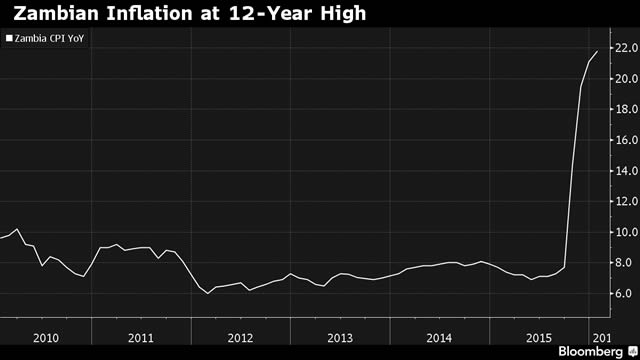
Last month, the country’s inflation rate reduced to 7.8 per cent from 9.1 per cent in May buoyed by decrease in some food prices such as mealie meal, maize grain, fresh vegetables and dried kapenta.
“Obviously in the short-term, it does affect our inflation as it will lead to an increase in prices but our expectation is that there will be other expansive programmes which will dilute the effect of this
power increase,” Dr Kalyalya said.
Dr Kalyalya said the kwacha which opened strongly this week climbing to the
highest level since mid-May and high maize output were expected to cushion the likely inflationary pressures from high electricity tariffs.
“The harvest is just still being offloaded onto the market so to the extent that there is going to be the pressure from the food sector to be able to moderate some of the pressures from the electricity
increase,” said Dr Kalyalya.
“The appreciation of the kwacha has already started. The performance of the exchange rate can help to moderate that impact.”
Labels: DENNY KALYALYA, TARIFFS, ZESCO
Read more...
BOZ expects banks to provide required level of finance – Kalyalya
By Joan Chirwa
Thu 17 Dec. 2009, 04:00 CAT
BANK of Zambia (BoZ) deputy governor for Operations Denny Kalyalya has said the Central Bank expects commercial banks to provide the required level of finance to consolidate economic gains registered so far.
During the launch of Barclays Bank Zambia Manda Hill branch in Lusaka on Tuesday, Dr Kalyalya said Zambia’s economy had been on the recovery path since the beginning of this year.
“As you may be aware, economies around the world have been negatively affected by the global financial and economic crises. Zambia, like most commodity exporting countries, was mostly affected by the second round effects of the crisis, especially in key sectors such as mining,” Dr Kalyalya said.
“I am, in this connection, happy to note that the overall performance of the financial sector has been satisfactory which should serve as a good basis for the lending we are talking about.”
He further noted that Barclays Bank, despite the setbacks from the financial crisis and its impact on the local economy, had continued to increase the number of distribution points throughout the country.
Dr Kalyaya said it was a well-known fact that branch expansion programmes played an important role in increasing access to the unbanked population in the country.
“However, there is need to complement physical branch expansion with other product innovation programmes that will capture a lot more people in the remote areas of our country,” Dr Kalyalya said.
“The real challenge for us is how to enhance savings mobilisation and effectively channel the public savings to most productive uses. It is for this reason that the Bank of Zambia has continued to encourage banks to offer an expanded range of innovative banking products.”
Dr Kalyalya further encouraged commercial banks and non-bank financial institutions in the country to continue taking a leading role in helping to improve the local financial services sector by providing greater access to banking services and products through a sustained and aggressive growth strategy.
“Needless to say that access to banking services and the contribution of the banking sector to economic development cannot be realised if the cost of accessing banking services continues to be high,” said Dr Kalyalya.
“The industry is characterised by high bank charges and interest rates. I therefore urge financial institutions to look into the issue of revising their pricing structure of banking products in order to increase access to financial services. As Bank of Zambia, we have taken up access to financial services as one of our strategic objectives for the period 2008-2011.”
And Barclays Bank Zambia chairman Jacob Sikazwe said the bank would remain committed to its goal of driving excellence in the financial services industry in Zambia even under the most difficult economic environment arising from the global financial meltdown.
Labels: BANKING, BARCLAYS BANK, BOZ, DENNY KALYALYA, JACOB SIKAZWE
Read more...
‘Mining concessions are enough to keep investors’
Written by Kabanda Chulu and Fridah Zinyama
MINING concessions are enough to make investors stay in the country, National Union of Miners and Allied Workers (NUMAW) president Mundia Sikufele has said, further challenging finance minister Situmbeko Musokotwane to stop linking windfall taxes to the non-attraction of investments.
And Bank of Zambia deputy governor Denny Kalyalya has said the 2010 budget targets are realistic and aimed at bringing back the Zambian economy on the recovery path.
Meanwhile, Zambia Institute of Chartered Accountants (ZICA) president Chintu Mulendema has said the 2010 budget has tried to capture most of the issues which are affecting the Zambian economy.
In his 2010 budget presentation last Friday, Dr Musokotwane expressed concern over critics who he said did not seem to appreciate the importance of failing to secure mining jobs and were advocating laws that might scare-away investors.
But Sikufele said government had again failed the people of Zambia for not putting up measures that would have allowed a huge percentage of mining profits to remain in the country.
“Having listened to the budget, as miners we are left with no option since we feel being treated like Cinderella’s. Currently the mining sector is booming and we expect to get something and it is wrong to link the windfall tax to non-attraction of investments since this tax only comes into play when there is unprecedented boom whereby the mines make super profits,” Sikufele said.
“So to whose interest is Dr Musokotwane and his team discarding windfall taxes and do they think Zambia is for charity and why should Zambia perpetually beg when we can do something about the various challenges we face?”
He said Botswana had reached medium income status because the government had put in place measures to ensure that 65 per cent of mineral wealth was retained in the country.
“Re-introducing windfall tax will not scare away investors since they have concessions that can make then stay and operate comfortably,” said Sikufele.
“Dr Musokotwane should not pretend that things are alright especially that mines were given chance when copper prices dropped to below US $ 3,000 per metric tonne but now it is over US $ 6,000 per metric tonne and we still want to give the mines a chance so at what level are we going to benefit as Zambians.”
However, Dr Musokotwane argued that the beginning of 2009 was a difficult environment but government managed to perform well and that the revised 4.3 per cent growth rate was achievable.
“Had it not been for bold decisions by government, the mining industry and the whole economy would have been in ruins today and it is against this background that changes were made to the mining tax regime,” said Dr Musokotwane.
Last Friday, Dr Musokotwane unveiled a K16.71 trillion budget for next year but ignored the calls from many Zambians to bring back the mining windfall tax, claiming that the taxes would scare away investors.
And former finance minister Ng’andu Magande said the budget would only give hope to Zambians when there was a serious implementation of projects in the sectors that required attention in the short to medium term.
“Generally it is looking good and if money is spent and projects implemented then there can be hope to uplift Zambians out of poverty,” he said.
When asked if it was wrong for Dr Musokotwane to leave out the mining sector in his budget speech, Magande said the speech did not contain everything.
“Speech doesn’t include everything but we have to read through the yellow book to see what will be gotten from the mines and I hope they have not asked for incentives because they got everything they wanted in the 2009 budget,” said Magande.
And Dr Kalyalya said the targets set out in the 2010 budget were realistic and tenable.
“In view of the global crisis, the trajectory set out in the budget is very clear especially if agriculture continues to perform better, the targets are realistic and they look tenable because we can exceed five per cent growth rate and eight percent inflation rate,” said Dr Kalyalya.
“We are emerging from a crisis and this budget is an attempt to bring us back to where we have been previously and if all those projects in agriculture, manufacturing and tourism take off, then Zambia shall soon be on the recovery path.”
And during a post budget dinner discussion held on Friday night, Mulendema acknowledged the challenges Dr Musokotwane could have faced in coming up with a national budget to address most of the issues the economy was facing due to effects of the global financial crisis.
“...2009 was a very difficult year for government as Zambia was experiencing the effects of the Global financial crisis,” he said. “Most sectors of the economy like the mining sector suffered job losses, trade declined and the tourism sector witnessed a reduction in the number of tourists coming to Zambia,” he said.
Mulendema said it was therefore government’s objective to try and rectify some of the problems which had been created by the recession in the national budget. And Dr Musokotwane said although the economic environment had been challenging, the country was on course to record the targeted growth rate of 4.3 per cent.
“I am still optimistic that Zambia could still attain the five per cent growth rate if things continue going at the rate at which they are going,” he said.
Dr Musokotwane said 2009 had been a difficult year for government as they experienced a budget deficit of about three per cent.
“We had compressed revenue as some of the estimates that we had made failed to come through due to the economic crisis,” he said.
Dr Musokotwane said balance of payment (BoP) from exports had gone down and imports were also affected due to the depreciation of the kwacha.
“Imports had gone down by 34 per cent,” he said. “Because our budget is also dependent on tax revenues, we failed to capture most of it because of a reduction in customs duty and value added tax.”
He explained that in order for government to be able to function well in the face of reduced revenues, they had to increase domestic borrowing.
“The country’s indebtedness is going to go up but this cannot be helped if we are to find funds to implement most of our developmental programs,” said Dr Musokotwane.
“Other countries are equally experiencing indebtedness, so we cannot exactly avoid that particular route.”
And giving a socio-economic analysis of the budget, Economics Association of Zambia (EAZ) member Lloyd Sichilongo said Zambia’s growth rate was expected to weaken due to the effects of the global financial crisis.
“This is because there has been a reduction in revenue from the mining sector, the largest contributor to the country’s economy,” said Sichilongo.
Labels: BUDGET, DENNY KALYALYA, MINING, MUNDIA SIFUKELE, NUMAW, TAXATION, WINDFALL TAX
Read more...
Kalyalya urges fight against dollarization
Written by Zumani Katasefa in Ndola
Sunday, July 05, 2009 4:29:58 PM
BANK of Zambia (BoZ) deputy governor Denny Kalyalya has urged Zambians to
fight dollarisation because it brings about volatility in the exchange rate. And Dr Kalyalya said the central bank is concerned with the use of dirty and mutilated notes in circulation.
Speaking on Friday at the ongoing 44th Zambia International Trade Fair (ZITF) in Ndola when he toured the Bank of Zambia stand, Dr Kalyalya said the central bank was concerned with traders quoting goods in United States dollars, saying this trend contributed to volatility in the exchange rate of the kwacha against other major currencies.
“I appeal to general members of the public to fight dollarisation. I appeal to people doing this to stop…this brings about the volatility in the exchange rate. If we all work together, there will be stability in our exchange rate,” he said.
He said the fight against dollarisation would be effective if institutions such as the Registrar of Companies were involved.
“For instance, the Registrar of Companies would put in certain conditions that would allow investors not to quote goods in dollars, this I am sure is going to help us fight dollarisation,” he said.
Dr Kalyalya said it was important for members of the public to also promote the use of clean notes by making sure that they properly handled the notes.
“We have a clear note policy, we want to have clean notes circulation. Members of the general public should also help promote the use of good notes in public,” DR Kalyalya said.
Dr Kalyalya also encouraged Zambians and non Zambians to invest in government bonds saying there were no restrictions on who should buy the bonds.
And Bank of Zambia assistant director for non-banking financial institutions Gladys Mposha said despite the global financial crisis, Zambia had seen a number of financial institutions coming into the country.
“We have not really seen the effects of this global financial crisis, capitalisation for the banking industry has even increased,” said Mposha.
Labels: BOZ, DENNY KALYALYA, GLADYS MPOSHA, KWACHA
Read more...
Economy not in recession – BoZ
Written by Kabanda Chulu
Thursday, June 25, 2009 3:23:08 PM
BANK of Zambia (BoZ) deputy governor Denny Kalyalya has said the country’s economy
is not in recession despite the current global economic crisis since
it has not recorded negative growth for two successive quarters.
And Dr Kalyalya has disclosed that
the impact of the recession in South Africa is already being felt on Zambia with
trade earnings with that country declining in the first quarter of 2009 by 40 per cent to US $ 346.8 million compared to US $578.3 million recorded in the same period last year.
Commenting on reports that the Zambian economy was going into recession, Dr Kalyalya said the Central Bank was facing challenges since there are limited tools to use to manage the economic indicators.
“There is need to bridge the information gap because we are having difficulties with having latest data, for example, the Central Statistical Office, do not have latest data on employment, it is not available but having limited tools to use to manage economy does not mean we are in a recession,” Dr Kalyalya said.
“We have been affected but not in the way others have been, mainly the Zambian financial sector is affected through the secondary wave since the mines have been working side by side with other sectors such as non-performing loans mainly from salaried employees who lost jobs but the banks are dealing with that issue, so we are not in a recession since we have not experienced two successive quarters of what is known as negative growth.”
He explained that an economy would slide into a recession when it experiences two successive quarters of what is known as negative growth.
“For this to happen, the total amount of goods and services produced by an economy, known as gross domestic product (GDP), will have to decline on a quarter by quarter basis for a total period of six months and the obvious signs of a recession include such indicators of decline in economic activity as decreases in employment, investment and corporate profits,” Dr Kalyalya said.
He further said it was regrettable that the rate of inflation was increasing around this time which was unusual.
“We are watching the situation very carefully because after harvest prices normally come down but this is not happening and it is regrettable that inflation is increasing in the second quarter,” he said.
On the expected effects of the recession in South Africa on the Zambian economy, Dr Kalyalya said 43 per cent of Zambia’s external trade was with South Africa.
“South Africa is a vital trading partner and recession there will lead to a decline in Zambia’s exports to that country due to falling demand. On the other hand, falling production in South Africa will leave little for exports to other countries including Zambia hence Zambia will have to look for other sources for imports, most probably at higher cost due to longer distances,” Dr Kalyalya said. “Therefore, a recession in South Africa will imply a fall in exports and a higher import bill and this will worsen Zambia’s balance of payments position, for instance, the impact is already being felt with trade earnings in the first quarter of 2009 falling by an estimated 40 per cent to US $ 346.8 million from US $ 578.3 million recorded in the corresponding quarter in 2008.”
He said many Zambian nationals were currently working in South Africa and remitting money back to Zambia to support their families.
“A recession may lead the incomes of some of the workers to decline and in other cases, the remittances may cease all together for those who may lose jobs following the recession. In that event, Zambians working in South Africa will send much less money to their families back home and Zambian families who rely on these remittances will experience economic difficulties and a fall in remittances will also lead to a reduction in the supply of foreign exchange in Zambia,” Dr Kalyalya said.
On South African foreign investment, Dr Kalyalya said declining economic activity in South Africa would also imply lower investment inflows from that country into Zambia.
“Zambia has received a substantial amount of foreign direct investment from South Africa in recent years resulting in a number of companies opening entities in Zambia but with recession, these companies may cut back on their expansion programmes in Zambia,î Dr Kalyalya said. ìOverall, the recession in South Africa, which is the largest economy in the region, may negatively affect the Zambian economy due to our strong trading relationship with that country and the South African recession is a reminder to us of the need to accelerate the diversification efforts that the country is implementing in terms of both production and directions of trade.”
And appearing before the parliamentary committee on Economic and Labour Affairs last week on the impact of the global economic crisis on Zambiaís economy and the operations and stability of the financial markets, Dr Kalyalya said the current financial regime had worked well in the country but needed further improvements.
“The situation is not as bad as it is been portrayed, it may look desperate for us but for those making comparisons, we are still an attractive investment destination and the liberal system has served us well, off course there are challenges and the impact is there since we share information and other linkages with other financial systems thus some spillover effects may affect us,” he said.
And responding to Luena MP Charles Milupi, who wanted to know what BOZ was doing to those foreign owned banks that were mopping up funds hence squeezing on lending so that money is taken back to their headquarters to sort out the crisis, Dr Kalyalya said BoZ was engaging the banks through the financial sector development plan to address those issues.
“The spread can be quiet high among banks but despite being foreign owned, normally the banks operate as subsidiaries and not as branches and we have stepped up supervision to ensure that they are not used,” said Dr Kalyalya. “We have also put measures in place such as not allowing borrowing on foreign markets for speculative behavior unless it is proved that money required will finance long term projects.”
Labels: BOZ, DENNY KALYALYA, GREAT DEPRESSION II
Read more...
Offshore investors shun State securities
...as they contribute to Kwacha fall
By Business Reporter
SOME offshore investors have lately been shunning Government securities in the money market, Bank of Zambia (BoZ) deputy governor for operations, Denny Kalyalya has said. The development has contributed to the kwacha’s depreciation against other convertible currencies.
In an interview in Lusaka, Dr Kalyalya said most of the offshore players in the money market were not as active as they had been in the past, when they have had to scramble for the Government’s treasury bills and bonds that the central bank auctions.
“One of the reasons for the pressure on the kwacha is that some of the players who buy Government securities have not been doing that lately,” he said.
The global financial crisis was also contributing to the appreciation of foreign currencies and leading to rising stock prices.
This in a way put pressure on the local currency, as investors in the offshore markets were playing a ‘wait and see’ game.
Dr Kalyalya said the other reason for the depreciation of the kwacha was attributed to the fact that inflows of foreign currency had reduced in the past weeks owing to reduced metal prices.
He explained that the fall in metal prices on the international market, which had seen the price of copper for instance drop from around US$8,000 per tonne in April this year to below $5,000 meant that the mining companies were earning reduced revenue from mineral sales.
“Therefore, when there is such a reduction in the foreign exchange earnings by the critical sectors, the exchange rate tends to move in the opposite way,” he said.
The BoZ deputy governor said other investors simply stayed away from committing their investments because of the uncertainty in the political environment.
As they await the outcome of the presidential election in a week’s time, they want to be sure about which of the contesting candidates would win and determine how safe their investments would be, he added.
Labels: BONDS, DENNY KALYALYA
Read more...
Islamic banking will help people
By KANGWA MULENGA
THE Bank of Zambia (BOZ) says the establishment of Islamic banking services in the country will help people to have access to money for capital investment without paying interest. BOZ Governor Caleb Fundanga said the central bank recently undertook a survey on the Zambian market, which revealed that 80 per cent of respondents intended to introduce Islamic banking products in the near future.
“The introduction of Islamic banking would come with its own challenges, for us at BOZ this entails further strengthening of our supervisory capacity,” Dr Fundanga said. He was speaking in Lusaka yesterday at the official opening of a two-day conference on Islamic banking held at Pamodzi hotel.
Dr Fundanga said in a speech read for him by BOZ deputy governor for operations, Denny Kalyalya, that Zambia would welcome the Islamic banking system because of its benefits to would-be customers.
Dr Fundanga said the rapid growth of Islamic banking raises a series of important questions, such as whether Islamic banking system should be regulated differently from conventional banking.
“We would welcome this challenge and hope to rise to the occasion by providing adequate supervisory infrastructure and an environment for conducting good business,” Dr Fundanga said.
He said modern Islamic banking was relatively new to most country’s rules for financial accounting, bank governance and lending standards.
Dr Fundanga said Zambia had been grappling with non-payment of loans by people that borrow money from banks, hence the services to be offered by Islamic banking system would assist people to access funds for capital investment.
“Of particular importance to Zambia is an arrangement where borrowers can borrow without paying interest.
Lending rates are very high in this country, thereby making borrowing for capital investment prohibitive…therefore an arrangement where borrowers can access funds for investment without paying interest is a worth exploring,” Dr Fundanga said.
He said the last decades had witnessed the rapid growth in Islamic banking both in terms of size and number of players.
Dr Fundanga said government recognises that the limited access to financial services and low number of products available to different sectors of the economy was hindering development potential of Zambia’s economy.
He has called for revitalisation of the financial sector to make it in line with the challenges of accelerated and sustained investment in key sectors of the country’s economy.
Dr Fundanga commended financial institutions in Zambia for rising to the occasion through broadening their scope of financial services beyond the traditional customers to include previously unbanked segments of society.
He was hopeful that the conference would provide an opportunity for stakeholders in the financial sector to share knowledge and experiences on how best to promote financial diversity and inclusiveness to all sectors of the economy by introducing and incorporating Islamic banking.
The Islamic banking system is being practiced in 50 countries worldwide.
Labels: BANKING, BOZ, CALEB FUNDANGA, DENNY KALYALYA, ISLAMIC BANKING
Read more...
Liquidity flows will remain strong - BoZ
By Kabanda Chulu
Friday August 22, 2008 [04:00]
THE Bank of Zambia (BoZ) has urged the public not to panic because liquidity flows in the financial markets will remain strong despite the death of President Levy Mwanawasa. Giving an update on the situation in the market yesterday, BoZ deputy governor for operations Dr Denny Kalyalya said uncertainty and nervousness gripped the financial markets when it was announced that President Mwanawasa had died.
"To reflect this, the kwacha recorded a depreciation of 1.8 per cent on this day and a further 4.1 per cent on 20 August 2008, to close the day at K3, 596.85 and K3,616.85 per US Dollar on the buying and selling sides, respectively," Dr Kalyalya said. "Although the exchange rate of the kwacha against the US Dollar moved in this manner, the underlying liquidity flows in the market remained very stable and this is indicative of the fact that the fundamentals (notably demand and supply factors) remained unchanged."
He said the Bank of Zambia was ready to provide liquidity support as deemed necessary.
"It is also important to reiterate that the Bank's monetary policy will remain focused on containing inflation and contributing towards broad-based macroeconomic stability.
As such, we will continue to monitor both the domestic and foreign exchange markets and take appropriate steps to stabilise the markets," said Dr Kalyalya. "So it is exceedingly important that all stakeholders remain calm and act constructively to ensure that macroeconomic stability is maintained as this is essential for economic growth and development."
Labels: BOZ, DENNY KALYALYA, LIQUIDITY, MAGANDE
Read more...