MoF was involved in privatisation of Zanaco - Lungu
By Ernest Chanda
Sun 05 Feb. 2012, 13:01 CAT
MUHABI Lungu says the Ministry of Finance was fully involved in the privatisation of Zanaco's 49 per cent shareholding although he is not sure of the minister's knowledge regarding proceeds from the transaction.
In an interview, Lungu who is former Zambia Development Agency ) director of Investment Promotions and Privatisation said whenever a state entity was being privatised, the line ministry was fully aware of the whole process.
Former finance minister Ng'andu Magande on Friday told the Sebastian Zulu-led Commission of Inquiry into the sale of Zanaco's 49 percent shares that the ministry did not play a role in the privatisation of the bank.
But Lungu said according to the ZDA Act, the relevant ministry was constantly informed about the whole development.
"According to the ZDA Act, the proceeds of all sales from the transaction of a privatised company go into a Privatisation Trust Fund which is held by ZDA. I don't know whether the minister is aware but the Ministry is aware that this money has gone into the Privatisation Trust Account. According to the ZDA Act, the money is only remitted to the government upon request by the government," Lungu explained.
"I don't want to appear to be answering what Mr Magande has said. So I don't want to respond to Mr Magande, I'm going to respond to the process. All state owned companies are held in Trust by the government, by the Ministry of Finance. They've got a department there called IDM, Investment and Debt Management. So, all the companies are held in Trust by the Ministry of Finance for government."
Lungu said any privatisation process started with the line ministry which gave policy direction.
He said for Zanaco, it was under the jurisdiction of two relevant ministries.
"That is the Ministry of Finance and the Ministry of Commerce. And I can only assume that the policy direction was given by those two ministries in terms of whether to privatise or not. Once a directive has been given that privatisation must now commence, then the relevant organisation then becomes Zambia Development Agency," said Lungu.
"The chances are that the US $8 million is in an escrow Account with ZDA because that is a ZDA loan. The money is only remitted to government upon request by the government. And the reason is very simple: when transactions have been finished and then workers perhaps had been declared redundant take their government to court and the court awards them compensation, what you don't want to do is give the money to the ministry because they sue ZDA, they don't sue government. So they will be paid from this account."
Appearing before the Zanaco Commission of Inquiry on Friday, Magande expressed ignorance about the whereabouts of the US$8.25 million paid by Rabo Bank of the Netherlands for the 49 per cent Zanaco shares.
Magande could not give categorical answers to some questions that were asked during his submissions to the Commission.
"I signed the sale and purchase agreement, shareholder agreement and management services agreement and I used to sign many other agreements giving away government assets bearing in mind that the documents were prepared by technical people at ZPA and that the Attorney General has endorsed them," said Magande.
"The finance ministry had a role in privatising Zanaco and it was convinced that ZPA negotiators would come up with a good price. So, I never got into details on how they arrived at US$8.25 million."
Labels: CORRUPTION, IMF, MINISTRY OF FINANCE, MUHABI LUNGU, NG'ANDU MAGANDE, PRIVATISATION, ZAMBIA PRIVATISATION TRUST FUND, ZANACO
Read more...
Ministry of Finance had no role in privatising Zanaco - Magande
By Kabanda Chulu
Sat 04 Feb. 2012, 13:01 CAT
NG'ANDU Magande yesterday told the Commission of Inquiry into the sale of Zanaco that he was not sure if the US$ 8.25 million paid by Rabo Bank for acquisition of 49 per cent shares went to the Treasury account.
And Copperbelt University Professor Juvenalis Tembo has said the negotiating team was not involved in determining the price of selling Zanaco shares and selection of the preferred bidder (Rabo Bank).
Magande, who was finance minister during the partial privatisation of Zanaco, could not give categorical answers to some questions that were asked during his submissions to the Commission.
He explained that the role of the finance minister in the process of privatisation was to sign away government assets held in state-owned enterprises that were sold.
"I signed the sale and purchase agreement, shareholder agreement and management services agreement and I used to sign many other agreements giving away government assets bearing in mind that the documents were prepared by technical people at ZPA and that the Attorney General has endorsed them," Magande said.
"The finance ministry had no role in privatising Zanaco and it was convinced that ZPA negotiators would come up with a good price so I never got into details on how they arrived at US$8.25 million."
When asked why he did not show interest in selling of state-owned enterprises (SOEs) especially Zanaco considering that the minister of finance is the custodian of government assets, Magande responded that his office was too busy to know full details of the transaction.
"Privatisation was not a subject matter of the job description that was given by the appointing authority and the process involved selling of over 300 SOEs so I would not look into the detailed transaction of each company. Besides the ministry of finance has no officer to undertake valuation because there is the government valuation department," Magande said.
"Bulk documents were brought to my office and I just signed and with Zanaco I signed the conclusion of the sales agreement though I was not part of the negotiations and US$8.25 million was too little to get my attention since I focused on much bigger things like the budget overrun that had occurred during that period and putting in place measures to ensure that the US$7.1billion debt was cancelled."
When asked how proceeds from privatisation were used and if at all Rabo Bank paid for the acquired shares, Magande said the privatisation Act had guidelines on usage of the funds.
"Money was paid by Rabo Bank but I am not sure if it went into the treasury or if an account was opened elsewhere," he said.
When asked if he played any role in the privatisation of Zanaco, Magande responded that he was briefed by the Zanaco chairman and other officials.
"I never interfered because it was not within my responsibilities and when they concluded negotiations the ZDA brought documents and I signed and also there was time when Vedanta bought KCM, again they brought documents saying this is urgent and I signed and I was aware about some concerns raised by stakeholders but I passed them over to ZPA officials," said Magande.
And founding chairman of Zanaco Andrew Kashita said the defective privatisation process of Zanaco must not be blamed on Rabo Bank but on Zambian negotiators who lacked national interest.
"We demand the publication of the valuation report and the technical and sales agreements. It is also difficult to understand why our people settled for this deal," said Kashita.
And Prof Tembo said he was appointed chairman of the negotiating team when Rabo Bank had already been selected as the preferred bidder.
"We were not involved in the selection of the bidder and we don't know how they arrived at the value price because we were just told to go and negotiate but terms and conditions had already been agreed so my team was just editing and not really negotiating," said Prof Tembo.
Labels: MINISTRY OF FINANCE, NG'ANDU MAGANDE, ZANACO
Read more...
Ministry of Finance had no role in privatising Zanaco - Magande
By Kabanda Chulu
Sat 04 Feb. 2012, 13:01 CAT
NG'ANDU Magande yesterday told the Commission of Inquiry into the sale of Zanaco that he was not sure if the US$ 8.25 million paid by Rabo Bank for acquisition of 49 per cent shares went to the Treasury account.
And Copperbelt University Professor Juvenalis Tembo has said the negotiating team was not involved in determining the price of selling Zanaco shares and selection of the preferred bidder (Rabo Bank).
Magande, who was finance minister during the partial privatisation of Zanaco, could not give categorical answers to some questions that were asked during his submissions to the Commission.
He explained that the role of the finance minister in the process of privatisation was to sign away government assets held in state-owned enterprises that were sold.
"I signed the sale and purchase agreement, shareholder agreement and management services agreement and I used to sign many other agreements giving away government assets bearing in mind that the documents were prepared by technical people at ZPA and that the Attorney General has endorsed them," Magande said.
"The finance ministry had no role in privatising Zanaco and it was convinced that ZPA negotiators would come up with a good price so I never got into details on how they arrived at US$8.25 million."
When asked why he did not show interest in selling of state-owned enterprises (SOEs) especially Zanaco considering that the minister of finance is the custodian of government assets, Magande responded that his office was too busy to know full details of the transaction.
"Privatisation was not a subject matter of the job description that was given by the appointing authority and the process involved selling of over 300 SOEs so I would not look into the detailed transaction of each company. Besides the ministry of finance has no officer to undertake valuation because there is the government valuation department," Magande said.
"Bulk documents were brought to my office and I just signed and with Zanaco I signed the conclusion of the sales agreement though I was not part of the negotiations and US$8.25 million was too little to get my attention since I focused on much bigger things like the budget overrun that had occurred during that period and putting in place measures to ensure that the US$7.1billion debt was cancelled."
When asked how proceeds from privatisation were used and if at all Rabo Bank paid for the acquired shares, Magande said the privatisation Act had guidelines on usage of the funds.
"Money was paid by Rabo Bank but I am not sure if it went into the treasury or if an account was opened elsewhere," he said.
When asked if he played any role in the privatisation of Zanaco, Magande responded that he was briefed by the Zanaco chairman and other officials.
"I never interfered because it was not within my responsibilities and when they concluded negotiations the ZDA brought documents and I signed and also there was time when Vedanta bought KCM, again they brought documents saying this is urgent and I signed and I was aware about some concerns raised by stakeholders but I passed them over to ZPA officials," said Magande.
And founding chairman of Zanaco Andrew Kashita said the defective privatisation process of Zanaco must not be blamed on Rabo Bank but on Zambian negotiators who lacked national interest.
"We demand the publication of the valuation report and the technical and sales agreements. It is also difficult to understand why our people settled for this deal," said Kashita.
And Prof Tembo said he was appointed chairman of the negotiating team when Rabo Bank had already been selected as the preferred bidder.
"We were not involved in the selection of the bidder and we don't know how they arrived at the value price because we were just told to go and negotiate but terms and conditions had already been agreed so my team was just editing and not really negotiating," said Prof Tembo.
Labels: MINISTRY OF FINANCE, NG'ANDU MAGANDE, PRIVATISATION, ZANACO
Read more...
COMMENT - Aauditor General Anna Chifungula is doing yeoman's (yeowoman's) work.
Finance ministry flouts financial regulations in banking mine tax
By Mwala Kalaluka
Sun 14 Feb. 2010, 04:33 CAT
THE action by the Ministry of Finance to
deposit the collected Windfall Tax amounting to K126,071,221,141 in an account other than Control 99 in 2008 was a
contravention of Financial Regulations, Auditor General Anna Chifungula has stated.
And Chifungula has highlighted that accounting and other irregularities have persisted at Zambia’s foreign missions going by an examination of financial and other records maintained at the Ministry of Foreign Affairs.
According to the report of the Auditor General on the accounts for the financial year ended December 31, 2008, Chifungula highlighted that not only was the Ministry of Finance’s action on the Windfall Tax a contravention of Financial Regulation number 130, but it also deprived the government of the required resources.
“Further, the amount was not recognised on Statement A1 and therefore understated the revenue reported as having been collected by government during the Financial Year ended 2008,” the report read. “In the 2008 budget, the Minister of Finance and National Planning (MoFNP) introduced the Windfall Tax for the mining sector.
This measure was intended to apply whenever prices of the metals increased beyond two times the cost of production. The measure was intended to ensure that the government gains from the sector as a result of the high metal prices on the market.”
The report stated that according to the Mines and Minerals (Ammendment) Act of 2008, failure to submit a return within fourteen days after the due date shall attract penalties, but that there was no evidence that penalties were charged on late submissions of returns.
“ZRA had provided a schedule indicating that a total amount of K126, 071, 221, 141 was collected against a total collectable amount of K896, 205, 033, 397 under the Windfall Tax leaving a balance of K770, 133, 812, 256 outstanding. However, there were no returns provided for audit scrutiny.
In addition, contrary to Financial Regulation No. 130 the Windfall Tax collected had not been remitted to Control 99 as of November 2009,” the report stated.
“In his response dated 25th November 2009, the Controlling Officer stated that the Windfall Tax collected by ZRA was deposited in the MoFNP Mineral Royalty and Windfall Tax at the Bank of Zambia and that the outstanding balance on the Windfall Tax was as a result of disputes raised by some mining companies that did not settle the Windfall Tax liability as they considered the new mining fiscal regime to be in conflict with the development agreements that existed with government, a matter which was still unresolved.”
The report stated that according to the Controlling Officer no amount of Windfall Tax was used in 2008 and that as at December 31, 2008, there was an outstanding balance of K307, 383, 881, 916.
“And that this was so because the government was still providing modalities on the utilisation of the funds,” the report read in part.
“However, the action by MoFNP of depositing the Windfall Tax amounting to K126, 071, 221, 141 in an account other than Control 99 was not only contrary to Financial Regulation No. 130 which requires that all revenue collected should be deposited into Control 99 but also deprived the government of the required resources for various government programmes.”
And the report revealed that contrary to Financial Regulation No. 20, travels documents that were received by the Zambian Mission in Washington in April 2009 had not been registered in the register and that there was lack of segregation of duties in that the receptionist was also in charge of processing passports and receiving revenue.
“Twenty (20) travel documents ranging from 272681 – 272700 that were received by the Mission in April 2009 had not been recorded in the register. In this regard, there was a risk that unauthorised issuing of travel documents may not be detected resulting in loss of revenue,” the report stated.
“Contrary to Financial Regulation, there were delays in banking of revenue collected during the period from January to December 2008 amounting to K1, 149, 775, 000 (US$254, 400) for periods ranging from two (2) to eighty eight (88) days.”
The report stated that contrary to Financial Regulations the staff at the Mission did not have expenditure returns to show how the revenue collected by them or expended under the head for which they were responsible were utilised.
It also indicated that there was an irregular payment of Foreign Service allowances outside the provision of Foreign Service Regulation number 56.
“A scrutiny of accounting and other records, however, revealed that the Ambassador was away from station from November 2007 to February 2008, a period of more than fourteen (14) days and was paid subsistence allowance totaling K24, 522 from the Ministry of Foreign Affairs while she was in Lusaka,” the report highlighted in part.
“It was observed that contrary to the regulation, the Ambassador was paid representational, entertainment and extra-accreditation allowances totaling K63, 576, 867 (US$17, 033.32) during the same period.”
Other highlighted irregularities was that on the payment of telephone bills where the report observed that in addition to the US$350, which is paid to head of missions on a monthly basis as telephone allowance for their residential and mobile phones, the Mission settled telephone and cell phone bills totaling K11, 819, 058.75 (US$3, 089.90).
“As of August 2009, no recoveries had been made,” the report revealed.
The report also stated that contrary to government accounting procedures the mission paid advances totaling K206, 705, 020 (US$53, 498) to 17 officers in 2008 without maintaining an advance register, making it difficult to verify whether all the advances paid were being recovered.
“Further, no imprest register (Accounts form 17) was maintained by the mission contrary to Financial Regulation No. 93,” the report stated.
“Imprest in amounts totaling K149, 159, 335.82 (US$39, 815.63) involving forty four (44) transactions issued to twelve (12) officers during the period from January 2007 to December 2008 had not been retired as of August 2009.”
The report stated that amounts totaling K10, 959, 300 (US$27, 289.50) were paid to BP AMOCO for the procurement of fuel for the Mission vehicles but that there were no disposal details as well as reconciliations availed to the audit to show the usage of fuel for each vehicle.
“Contrary to procurement guidelines, the Mission purchased goods and services amounting to K167, 077, 908 (US$43, 185.53) without obtaining three (3) competitive quotations,” the report read in part.
Labels: ANNA CHIFUNGULA, CORRUPTION, MINING, MINISTRY OF FINANCE, WINDFALL TAX
Read more...
Govt considers revising inflation target
Written by Kabanda Chulu
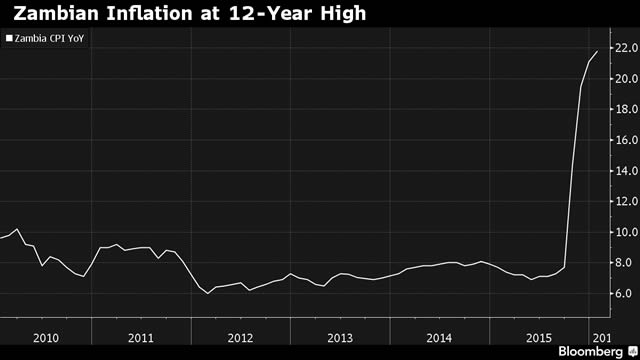
GOVERNMENT is considering revising the inflation target from the anticipated seven per cent to about 12 per cent following the current economic trends that outweigh the attainment of a single-digit inflation.
Sources at the Ministry of Finance yesterday said the government would however maintain the seven per cent target of economic growth rate.
Finance minister Situmbeko Musokotwane could however not comment on the matter as he was reportedly in a meeting.
The sources said the issue of food, especially the increase in maize prices, was creating a huge inflationary pressure hence the decision to change the inflation target because it appeared unattainable.
“We are still hopeful about the economic growth rate of seven per cent but we do not think that the inflation target of seven per cent will be met especially that various factors such as food is creating too much pressure and the target that is likely to be met by the end of the year is between 10 to 12 per cent,” said the sources. “This will be possible since government has taken some measures to ensure there is a reduction in prices for food especially maize as you know food especially mealie meal plays an important role in the attainment of required inflation targets.”
According to the Central Statistical Office, the inflation rate for October stood at 15.2 per cent, only two months before the end of 2008.
And last week, the Economics Association of Zambia (EAZ) observed that it was unlikely for Zambia to end the year with a single-digit inflation rate because of many factors against its attainment.
The EAZ noted that there were many factors outweighing Zambia’s attainment of its economic targets than those that would contribute to its attainment.
It cited the uncertainties surrounding the global food supply and the continued price increase of food such as maize meal on the local economy.
Other variables, according to EAZ, that would have a huge impact on the attainment of the targets include the cost of energy which is still rising for both fuel and electricity and also increased government spending towards last month’s presidential elections contributed to high inflationary pressures.
Recently, the Bank of Zambia observed that government’s removal of subsidies on domestic fuel prices and the global food crisis were threatening the attainment of the seven per cent annual inflation target. The Central Bank also noted that inflationary pressures would further arise from several factors that include the increasing global oil prices and the 15 per cent wage increase for government workers.
Labels: INFLATION, MINISTRY OF FINANCE
Read more...
These are some of the collected articles from dr. Situmbeko Musokotwane, the recently appointed Finance Minister.
ICT has potential to reduce public sector spendingGOVERNMENT will ensure that the Information and Communication Technology (ICT) sector is given priority because it has the potential to reduce public sector spending by attracting private local and foreign direct investments.
Deputy Secretary to the Cabinet Situmbeko Musokotwane said
Government had put in place the Zambia Development Agency (ZDAA) Act and the Citizens Economic Empowerment (CEEA) Act and that the two instruments were designed to increase the economic performance of all sectors in the country.
Opening a three-day ICT draft bill stakeholders consultative meeting at Mulungushi International Conference Centre in Lusaka yesterday, Dr Musokotwane said ICT would be used as an effective tool for poverty reduction because it had the potential to substantially advance progress towards the attainment of Millennium Development Goals (MDGs).
Dr Musokotwane said the ZDAA and CEEA instruments were designed to increase the economic performance of all sectors in the country but stressed that this would only become a reality if the ICT sector’s legal and regulatory framework was supportive of the broader social and economic policies of Government.
He said the ICT sector was steadily becoming the leader in investment in the country and that the high level of confidence was shared by the corporate world in Zambia as reflected in the first ever Business Leaders Confidence Index (BLCI) for Zambia recently undertaken by the Steadman Group which revealed that the ICT sector was a leader in confidence by having 61 index points, the highest points above any other sector in the country.
He said in order to maintain the momentum, a dynamic legal and regulatory framework was imperative to act as the foundation for the development of the ICT sector and that Government had since committed itself to establishing an autonomous regulatory body capable of implementing the vision of a fully liberalised ICT sector.
Government had also committed itself to promote the development of licensing framework that take into account the use of cost -effective technologies and systems that could assist in increasing access to the ICTs especially in rural areas.
“As you discuss the ICT bill, it is important to note that in the national ICT policy, the Zambian Government has committed itself to developing appropriate institutional, legal and regulatory frameworks in order to support the development of a competitive local ICT sector and an information society based on coverage, fair, predictable and transparent legal and regulatory system,” he said.
He said Government through the Ministry of Communication and Transport and the Communication Authority had begun implementing some of the commitments made in the policy including the development of a new legal framework.
At the same function, Communication Authority chief executive Shuller Habenzu said the workshop was aimed at shaping the direction of the sector to meet not only current and future industry requirements but would focus on regional and international best practices so that Zambia benefits from its membership to the global village.
[Times of Zambia]
http://www.times.co.zm/news/viewnews.cgi?category=3&id=1079493974
Opinion
THE summary of what Secretary to the Treasury Situmbeko Musokotwane said before the Parliamentary Public Accounts Committee yesterday is that Government needs to apply fiscal discipline more than any other time before.
Dr Musokotwane admitted before the committee that it was becoming increasingly difficult for Government to spread the little resources because the demands were high against a lean income inflow.
“We need to ask ourselves honestly and fairly, how many institutions can we afford to fund. Given the resource base, we have too many institutions to support and at the end of the day our expenditure levels are too high,” he told the parliamentary team.
The revelation that the size of Government is large is not new at all, but rather what is encouraging is that difficult as the task is, some measures are being taken to correct flaws such as over-expenditure.
According to Dr Musokotwane, even the supplementary expenditure on defence and Office of the President will now have to be tabled before Cabinet for necessary surgery. That means there is no sacred cow anymore.
Every one has to sacrifice for the country to move forward.
It is also good that authorities are responding to public concerns on the need to trim the size of Government. Suggestions from the public and recommendations of the national Indaba last September on the issue are all being taken on board.
This, as mentioned before, is a very difficult and challenging task which will call for more than just sacrifice. Government has to do all it can to boost resources and may need the helping hand of co-operating partners.
But what is more important is for the system of Government to begin adjusting. There is need for internal discipline. In the past there have been cases of over-expenditure and diversion of some resources.
As Dr Musokotwane revealed, funds from the fuel levy that were taken elsewhere is an example. Such things have to be stopped.
However, as the committee directed, there appears to have been gross misapplication of Highly Indebted Poor Countries (HIPC) funds.
Everything must be done to follow up the culprits. More importantly stringent controls are central to curbing further misuse of funds.
The country has a serious assignment to reach the HIPC completion point. This will only be possible if conditions are met.
Controlling officers in Government therefore have a mammoth task to monitor each and every expenditure.
Every coin should be accounted for. Internal weaknesses, as the parliamentary committee observed account for most lapses, and have contributed to misuse and misapplication of funds in the system. There is need to turn a new leaf for Zambia to succeed. Fiscal discipline is the critical factor.
http://english.peopledaily.com.cn/200511/22/print20051122_223205.html
Zambia expects 6 percent GDP growth in years ahead
The Zambian government has projected an average of six percent growth in its gross domestic product (GDP) between 2006 and 2008, the official Times of Zambia newspaper said Tuesday.
The projection is contained in the Medium Term Expenditure Framework released by the government Monday.
Situmbeko Musokotwane, secretary to the treasury, was quoted as saying that mining and construction will continue to dominate the growth process, especially with the opening of major new copper mines in the Northwestern Province.
Other sectors that should contribute to the growth include manufacturing, tourism, transport, storage and communications, he said.
Musokotwane said the government would focus on labor-intensive sectors such as agriculture and manufacturing.
"In this regard, particular attention will be on expanding rural infrastructure such as feeder roads, bridges and dams, among others," he said.
Zambia recorded a 4.6 percent GDP growth rate in 2004, thanks mainly to increased copper production, its single biggest forex earner. The government has projected an even stronger growth for 2005.
Source: Xinhua
http://english.people.com.cn/200512/26/print20051226_230898.html
Zambia to explore possibility of leasing oil refinery
Zambia is to explore possibility of leasing its sole petroleum refinery to private investors, Zambia Daily Mail reported Monday.
Situmbeko Musokotwane, secretary of the treasury, was quoted as saying that the move aims at encouraging new private investment into Indeni petroleum refinery in the northern Zambia to improve its efficiency.
The refinery has been dogged by frequent breakdowns leading to fuel shortages in the southern African inland country.
Musokotwane said the government will instead focus its attention to managing fuel strategic reserves as opposed to running the refinery.
The government is carrying out a legal and technical review on Indeni to recommend options on the future of the plant, he said.
http://www.ciol.com/News/News-Reports/Zambia-Govt-keen-on-investments-from-India/16108102856/0/
Realizing the importance of IT, Republic of Zambia has declared education priority sector. "The government has decided to attract giant investments from Asia particularly India. This will help increase skills training and create job opportunities. We don't have enough schools for children. We are hiring more teachers and learning materials. We don't have adequate facilities too. The government is also looking at attracting investments in tourism, agriculture and other areas," Dr Situmbeko Musokotwane, economic advisor to the President of Zambia told CIOL.
The delegation, which visited the IT capital on Tuesday to explore possibilities of attracting investments to Zambia, has seen signs of investments from Mysore. This was evident when the Dr Situmbeko Musokotwane and High Commissioner Keli Walubita invited Raman International Institute of Information Technology (RiiiT)- India's first IT finishing school supported by Karnataka Government, to set up Information Communication Centre (ICT) centre in Zambia.
Labels: CABINET, ICT, MINISTRY OF FINANCE, SITUMBEKO MUSOKOTWANE
Read more...
Shakafuswa warns defaulting contractors
By Chibaula Silwamba
Wednesday January 16, 2008 [03:00]
Finance and national planning deputy minister Jonas Shakafuswa has warned that companies that have government contracts and default on tax payments will be blacklisted. In an interview yesterday, Shakafuswa said he had directed the Zambia Revenue Authority (ZRA) to investigate all companies that have contracts with government to verify if they are tax compliant or not. He said those that would be found to be defaulting on tax payments would never be given the government contracts again.
"For me to be able to give a contract or even pay those with outstanding bills, they have to show that they are tax compliant and the money we are paying is also going towards payment of taxes," Shakafuswa said.
"For big government contracts, I have discovered that there are a number of people who are not tax compliant; they are putting in fake tax clearance certificates in the bids."
He said it should not only be Tomorrow Investments to be investigated but several others and they should be prosecuted.
Shakafuswa said he knew many companies that were not paying taxes.
"I have companies in mind but they are being investigated, I can't give you the names now because we are investigating them," said Shakafuswa.
"What I have done is that I have directed ZRA to investigate all major contracts in the last two years and make sure that everybody has been captured especially for big institutions like Ministry of Health, Ministry of Education, Ministry of Works and Supply, ZRA will move in and audit all tenders given and make sure that all tenders have been given properly."
Labels: CONTRACTORS, JONAS SHAKAFUSWA, MINISTRY OF FINANCE, TAXATION, ZRA
Read more...
Finance ministry fails to account for K1.9 trillion
By Chris Mulaliki in Solwezi
Friday July 06, 2007 [04:00]
AUDITOR General Anna Chifungula has disclosed that the Ministry of Finance and National Planning has failed to account for K1.9 trillion in unreconciled transactions at the Bank of Zambia. Addressing provincial heads of government departments and accountants at the Boma conference in Solwezi, Chifungula said the unreconciled transactions between the Ministry of Finance and the Bank of Zambia had been exposed in the consolidated financial report for 2005 released by the Accountant General.
“No one has been able to explain to us where the money went and how it was used at the Ministry of Finance. These unexplained financial transactions of K1.9 trillion between the Ministry of Finance and Bank of Zambia are in the 2005 consolidated financial report which has just been released by the Account General,” Chifungula said.
She explained that Ministry of Finance withdrew money from the government account at the Bank of Zambia for various projects in the country. She said her office audited old reports because the accountant general delayed in releasing financial reports.
“As long as the system remains manual, we will continue to audit old reports. We can’t make it earlier because we do not have the technology,” she said.
Chifungula told the provincial heads of government departments to be accountable and stop misapplication of government funds. She said she would write to the Secretary to the Treasury to consider decentralising the recruitment of internal auditors.
She observed that most departments did not have internal auditors hence the misapplication of government funds.
“Internal auditors help to ensure that funds released by government are spent according to laid down projects,” Chifungula said.
And North Western Province permanent secretary Richard Salivaji urged the provincial heads to follow laid down procedures in the expenditure of government resources.
Salivaji said government had released a lot of money for projects in the province that should be put to good use.
“Misapplication and misdirection of government funds is a problem and ignorance is no defense. Some of you do not even visit the districts,” Salivaji said.
Labels: ANNA CHIFUNGULA, CORRUPTION, MINISTRY OF FINANCE
Read more...