COMMENT - The
Eurobonds,
IMF/WB,
Privatisation,
Anglo-American Corporation and it's many holdings (
De Beers,
Tongaat Hulett) all lead back to the same family and banks. When dealing with one, you are also dealing with the rest.
ZCCM-IH says FQM defrauded it repeatedly from 2006 to 2012 by hiding profits from Kansanshi Mining Plc and using proceeds from that period of high copper prices to build other mines without its consent as a shareholder.
The FQM executives sued by ZCCM-IH included chairman and chief executive officer Philip Pascall and directors Arthur Mathias Pascall, Clive Newall and Martin Rowley.
Mike Mulongoti:
He further asked the rationality of Zambia yearning to borrow from the International Monetary Fund (IMF) an amount of US$1.6 billion when they were in cahoots with FQM over US$1.4 billion.
We are convinced that they must have been paid because there is no way they can insist on going to the IMF to borrow US$1.6 billion and yet there is more than US$2 (billion) from the mine that they are trying to collect. How can that be?
Because the family that owns the mines is the same family that controls the IMF/WB, and they're making money both ways.
(THE MAST ZM) State House wants to rob Zambians through the ZCCM-IH, FQM fraud case – Mulongoti
Malawo Malawo
MIKE Mulongoti says State House’s attempt to rob Zambians out of billions of kwacha from First Quantum Minerals must viciously be watched and later followed up.
According to reliable sources, State House has bowed to pressure and is forcing Zambia Consolidated Copper Mines-Investments Holdings (ZCCM-IH) to discontinue the fraud case in which it claims First Quantum Minerals (FQM) swindled it out of US$1.4 billion.
In November last year, ZCCM-IH, which holds shares on behalf of the Zambian government in the privatised and now foreign-owned mines, sued FQM in the Lusaka High Court for fraud and simultaneously commenced an arbitration process in London in an attempt to recover the money.
ZCCM-IH says FQM defrauded it repeatedly from 2006 to 2012 by hiding profits from Kansanshi Mining Plc and using proceeds from that period of high copper prices to build other mines without its consent as a shareholder.
The FQM executives sued by ZCCM-IH included chairman and chief executive officer Philip Pascall and directors Arthur Mathias Pascall, Clive Newall and Martin Rowley.
On April 21, 2017, Arthur, the director of operations, wrote to Attorney General Likando Kalaluka requesting him to force ZCCM-IH to drop the matter that is actively before the courts of law. The FQM directors also asked Kalaluka to protect them from prosecution. As the matter continued being battled in the Lusaka High Court, State House press aide Amos Chanda announced on May 10 that President Edgar Lungu would interfere in the ongoing legal dispute between ZCCM-IH and FQM and direct the matter to be settled outside the courts of law.
And last week, while the case was being heard in court, the Ministry of Finance issued a statement saying the first round of negotiations on the matter were fruitful.
Commenting on the matter, Mulongoti, the People’s Party president, observed that there was no morality in President Lungu’s government. He wondered what incentive was there for President Lungu, who recently hinted that he did not interfere in active court processes, to now call for a friendly resolution of the ZCCM-IH and FQM legal battle.
We have a problem when it comes to the issue of integrity in the PF government. The President, together with his spokesperson, has emphatically said they will not interfere with any court issues. When the outside world and everybody was persuading him to secure the release of HH (Hakainde Hichilema), he refused! Now, there is a court process (between ZCCM-IH and First Quantum Minerals) which involves resources of Zambia where ZCCM-Investment Holdings want to get money from an investor who has behaved dishonestly and he wants to intervene! How?
Mulongoti, who served as a Cabinet minister in various ministries during the MMD reign, wondered in an interview in Lusaka.
“This is a matter that must be followed up very viciously. What we’ll see is that they will become richer and Zambia will get poorer! They (FQM) have spent money that is supposed to come to Zambia on developing their own companies and the (ZCCM-IH) chief executive officer Dr Pius Kasolo is trying to get that money back. But for whatever reason, they (government) want to stop that money coming back to the people of Zambia.”
He further asked the rationality of Zambia yearning to borrow from the International Monetary Fund (IMF) an amount of US$1.6 billion when they were in cahoots with FQM over US$1.4 billion.
We are convinced that they must have been paid because there is no way they can insist on going to the IMF to borrow US$1.6 billion and yet there is more than US$2 million from the mine that they are trying to collect. How can that be? Mulongoti asked.
“So, there is no reason to allow them even to go to the IMF if they can’t collect that money which is here! This issue of insincerity is not right and along the way, the people of Zambia who are suffering will demand for little more than just ordinary explanation.”
He cautioned those who were currently looting public funds in the PF government that money could not be hidden.
They have become so rich such that some of them don’t even know what to do with the money. There is no secret in the world today -whether you’ve hidden your money in South Africa, Dubai or wherever, we’ll get to know and the people of Zambia will demand for that money, cautioned Mulongoti.
Labels: CORRUPTION, DEBT, EDGAR LUNGU, EUROBOND, FQM, IMF, NEOLIBERALISM, PF, PRIVATISATION
Read more...
COMMENT - IMF: please don't pay off those Eurobonds so quickly.
(LUSAKATIMES) IMF advises Zambia to delay re-financing $2.8 billion of Eurobonds
December 14, 2016
Zambia should delay its planned re-financing of $2.8 billion worth of Eurobonds until financing conditions ease, an International Monetary Fund representative said on Monday.
“We would caution the government not to tap into the international markets at this time,” the
IMF’s resident representative, Alfredo Baldini, told reporters during the release of an IMF report on growth in sub-Saharan Africa.
The Eurobonds were issued from 2012 to 2015, and the Zambian government planned to re-finance them with longer-dated bonds at a lower cost, Finance Minister Felix Mutati said on Dec 7.
“The financing conditions are pretty tight right now, and it will be very expensive,” Baldini said on Monday.
In fact, the bonds would only fall due in 2022, 2024 and 2025, so the government didn’t need to rush into re-financing them, Baldini said.
The Zambian government has relied on external financing as its spending rose over the past few years while revenue remained almost the same, which has put pressure on its exchange rate, Baldini said.
Mutati said last week the equivalent of 19 percent of Zambia’s gross domestic product was being used to service debt and the government wanted to reduce that to about 15 percent.
Zambia issued a $750 million Eurobond in 2012, followed by a $1 billion issue in 2014 and another worth $1.25 billion last year, mainly for infrastructure projects.
Labels: ALFREDO BALDINI, EUROBOND, FELIX MUTATI, IMF
Read more...
(LUSAKA TIMES) PF Government , IMF reach deadlock over bailout
COMMENT - The IMF goes to town. They want charges to go up, and that is after the massive devaluation of the Zambian Kwacha through Eurobond debt and other borrowing
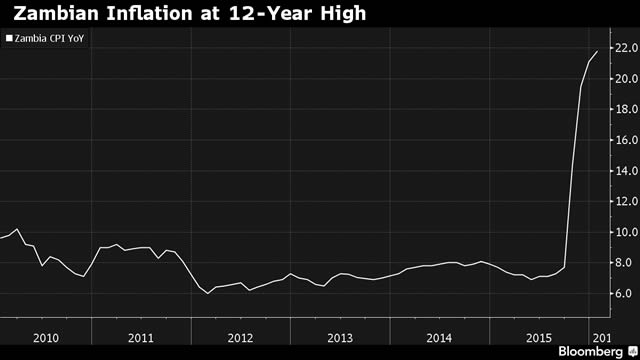
leading to record inflation - with full knowledge and approval of the IMF and World Bank - they are complicit in this crime. This is not an economic policy, this is a hit. And the only thing the PF government of President Lungu can say is - let's wait until after the elections? This is criminal. Oh by the way, they are speaking in euphemisms because they're crooks. This is a massive transfer of resources from Zambian people to the IMF/Eurobonds. I say: scrap ALL the debt, throw the crooks in jail and take back the mining companies' stocks. Makes ZCCM great again, and completely transparent to the public. Use the profits to get into copper manufacturing using local copper only. Diversify into agriculture and infrastructure. That is the only way forward, not this neoliberal austerity and global economy garbage.
(LUSAKA TIMES) PF Government, IMF reach deadlock over bailout
March 18, 2016
President Edgar Lungu has asked the International Monetary Fund to offer an emergency bail out to his government but only start implementing the needed austerity measures after the August elections.
President Lungu through Finance Minister Alexander Chikwanda made the plea when he met an IMF mission team that was in Zambia over the last two weeks.
The IMF is however not willing to offer emergency financing to the Zambian government before the country’s authorities submit a detailed technical report on how it will stabilise the economy.
This led to a deadlock and the much expected deal was not agreed at the end of the mission.
Impeccable sources who attended part of the consultations with the IMF team revealed that President Lungu was begging the IMF to relax its terms and allow his government to start implementing key austerity measures after August.
The sources said President Lungu contended that implementing a full set of austerity before the August elections will make it impossible for him to secure re-election.
Among the key measures the IMF team is demanding that government implements includes the removal of fuel subsidies, a serious reform of the Farmer Support Programme, introduces cost reflective power tariffs and a slowdown in infrastructure spending.
And in an End-of-Mission statement released on Friday, the IMF said the Zambian government indicated that strong near-term measures are being evaluated and that, at the IMF/World Bank Spring Meetings in mid-April, they would provide further guidance on the policy direction and reforms, and their plans for an IMF-supported program.
“Government finances are under immense stress. Expenditure is running far above budget, in large part as a result of fuel subsidies and contracted emergency electricity imports that together are estimated to cost the treasury about US$660 million a year at the current pace (equivalent to 3.2 percent of GDP). At the same time, domestic and external financing options have become more limited along with rising interest rates. Mounting domestic arrears are adding to concerns about debt sustainability,” the IMF said.
It added, ““tightening of monetary policy has been effective in stabilizing the exchange rate but tight liquidity conditions have contributed to persistent under-subscription of treasury bills and bonds. However, there is little scope to loosen monetary policy as long as fiscal imbalances are not addressed. A key challenge going forward will be to normalize activity in the interbank foreign exchange market while avoiding a return of last year’s extreme volatility in the exchange rate.”
The IMF said its mission and the Zambian government reached a shared understanding of the challenges and risks associated with the current economic situation.
“The authorities stressed that, notwithstanding the upcoming general elections, they are committed to addressing the budgetary pressures, including moving to cost-reflective energy pricing, and scaling back on discretionary spending while safeguarding social protection programs. They indicated that strong near-term measures are being evaluated and that, at the IMF/World Bank Spring Meetings in mid-April, they would provide further guidance on the policy direction and reforms, and their plans for an IMF-supported program,” it said.
“The mission is confident that Zambia’s current economic challenges can be overcome with resolute policy action, allowing a resumption of growth in line with the country’s abundant potential. In particular, a package of measures that makes clear that the fiscal pressures are being tackled would boost market confidence and pave the way for increased investment and growth. However, delays in implementing corrective measures will only worsen the situation, increase the adjustment cost and postpone the recovery.”
Labels: EDGAR LUNGU, EUROBOND, IMF, MMD, PF, World Bank
Read more...
COMMENT - One of the consequences of loading the government up with debt, courtesy of the WB/IMF's Eurobonds, is that it devalues the currency. Which means that ordinary people are already paying for it. This is odious debt, and it has to be scrapped.
Kwacha fall frustrates shoppers in Lusaka
By Chambwa Moonga |
Updated: 15 Oct,2015 ,11:55:41
THE buying power of the kwacha has left most Lusaka residents frustrated. And the number of people, mostly women, who used to ‘overwhelm’ Pick n Pay outlet at Levy Shopping Mall in Lusaka to order bread, has severely dropped, owing to an increase in order prices of the commodity. Just this year alone, the troubled kwacha has tumbled by over 40 per cent against the US dollar, a trend that has triggered worrying price increments on several goods, especially imported products.
A check at Shoprite Manda Hill on Sunday showed that prices had been adjusted upwards on basic household commodities.
Five litres of Sun Soya cooking oil was found pegged at K114.99 while a 2.5 litres of the same commodity and brand was at K59. 99 from around K65 and K30 on average respectively a month ago.
A sack of onion cost K39. 99, a kilogramme of white refined sugar was fetching K11, 99 from K8, while two kilogrammes of sugar is now K18.29 from around K15. In the same store, baby cereal was pegged at K21. 99, with a 200 grammes of Johnson baby powder going at K29.99.
A loaf of white bread costs K4.99; two litres of Zambeef milk was going at K17. 99 from around K12, while a tray of 30 eggs was pegged at K29.99 from an average of K21. A 10kg bag of Mealile breakfast mealie meal was at K37.49 with roller meal of the same quantity pegged at K29.49. A 25kg bag of breakfast mealie meal from National Milling Company was going at K71.99.
Inside sources at the uptown store hinted that there has been a price increment of between K2 and K20 in recent months on most commodities, in response to the kwacha fall.
Most shoppers were seen pushing their quarter or half parked trolleys as others walked about with ‘lightly’ parked shopping paper bags.
Another check at Melissa Supermarket in Northmead area revealed that prices of essential goods are equally rising.
An anonymous source, when approached within Pick n Pay, said “Mitengo yama order banalundila; that’s why mwaona ati bo order lelo bachepa. Nima loss yekayeka apa manje (the order price for bread has been increased and that’s why you are only seeing a few people ordering today; selling bread is now a loss-making venture.”
The price of bread in most of Lusaka’s highly populated areas is now costing between K8 and K8.50.
Recently, PF secretary general Davies Chama said if Zambians buy expensive and luxurious bread and mealie-meal, they would think Zambia’s economy is bad when, in fact, such a phenomenon is only in their pocket.
“A lot of people have been speculating that bread is K8, K9, but go to Shoprite, you will find the price of bread at K4! But if you want to eat luxurious bread, it means you want to eat expensive bread; then it will be expensive. I was looking at the price of mealie-meal in a shop; it’s K70 per 50 kilogramme bag. I was looking at the price of Boom (washing paste), it’s K4.50. So, when people are saying the economy, the economy, some of the people it is the economy in their pockets. It’s not about the price index,” said Chama.
Labels: EUROBOND, INFLATION, KWACHA
Read more...
COMMENT - Of course it is the absence of the profits from the Windfall Tax, combined with debt from the Eurobonds, that is costing the nation. The corruption starts at the top, right from the IMF/World Bank and their conditionalities like Privatisation down. No governments with the backbone to stand up against them, or the imagination to get together with SADC and the AU and make common cause to sidestep this system.
(LUSAKATIMES) Zambia’s Inconsistent mining taxation policy is costing us
September 16, 2015
File:NCHANGA Mine rescure Team B Captain Jonathan Kolala inspects air underground during the Zambia
Mine Rescure Association competetion at Namundwe Mine
The mining industry is a sore topic for many Zambians; a source of pride and pain depending on where you seat on the fence. Copper is the nation’s main export and the mines are the largest formal employer after the civil service. Those employed in the mining sector are among the most well paid workers in the country. Mining activities have contributed to the growth of mining towns on the Copperbelt, Solwezi being the most recent development.
However, Zambia is still struggling to capture tangible benefits from this mineral wealth endowment for the wider population. Despite being the second largest copper producer in Africa, copper is still exported in its raw form, and the general feeling among the population is that most of the profits are expropriated. In september 2014, Zambia experienced a lot of turmoil in the mining sector, with both Glencore and Barrick Gold threatening to stop operations if differences between the companies and the government were not resolved by January 2015.The major cause of this standoff was a lack of transparency on revenues and profits from the mining companies and a lack of consistent and effective mining taxation policy from the government. This standoff is back, and taxation policy is still a key issue of contention.
Every change of government has seen an adjustment for better or worse, with the claim of serving the countries best interests.
To try and capture benefits for the local economy from copper, the Zambian government has had many changes the mining taxation policy. Every change of government has seen an adjustment for better or worse, with the claim of serving the countries best interests.
Windfall Tax
One of the best changes enacted to the tax regime was during Levy Mwanawasa’s government, which saw mineral royalties increase from 0.6% to 3%, corporate tax from 25% to 30% and a 5 cent windfall tax per pound on any copper sold above a designated market price. However, the windfall tax was over turned by Rupiah Banda’s government due to pressure from mining companies to scrape the new reforms. They claimed that the tax was creating an ‘unattractive’ business environment for the country, despite favourable copper prices on the international market at the time. The mining companies succeeded by using contractual obligations and the financial crisis. On the other hand, the government conceded to this pressure arguing that Zambia was the only country in the region that had a windfall tax at the time. The government did not see this as an opportunity to be a leader in effecting a positive trend for regional mining taxation.
Mineral Royalties
In 2012, Michael Sata’s government again made changes to the tax system with mineral royalties increased from 3% to 6%. However, the windfall tax was not reintroduced. While the Zambia Institute for Policy Analysis and Research (ZIPAR) admits that tax revenues in the country have increased considerably since Mwanawasa’s government, they have made it clear that it is hard to pin this growth on tax regime changes as copper prices and production have also increased consistently during the same period. Further, the Zambia Revenue Authorities (ZRA) has also improved its tax monitoring and administration capacity.
VAT
In September 2014, the impasse between mining companies and the government involved two main issues, both closely related to taxation. Firstly, the mining companies were claiming a $600m refund on VAT from the government, and secondly, the government had more than tripled the mineral royalty tax beginning January 2015 from 6% to 20%, a move that the companies found highly unacceptable. According to VAT Rule 18, companies can claim VAT on inputs for exported goods produced in the country. However, companies find it very hard to claim these tax refunds due to the administrative requirements of the act. This led to the suspension of operations by Glencore at the beginning October 2014 based on unclaimed VAT refunds. Currently, Mopani is threatening to lay off 4 000 workers and is citing non VAT refunds as one of the key reasons for this.
ZRA requires that companies produce a number of documents in order to claim VAT refunds; a shipment certificate provided by the ZRA, a certificate provided by the customs authority in the importing country, invoices for the goods exported, proof of payment into the exporter’s bank account in Zambia and such other documentary evidence “as the authorized officer may reasonably require”. While companies complain that the administrative requirements are too much, this is documentation that is readily available to them as they carry out their transactions. Therefore, the lack of transparency among mining companies has also contributed to delayed payments of VAT refunds from government.
Zambians are not very clear about how much revenues we should be earning from the mining sector Currently Zambians are not very clear about how much revenues we should be earning from the mining sector. These documents required when claiming VAT refunds can provide this information, and help combat the high suspicions of tax evasion in the mining sector.
Mining companies must not be allowed to dictate policy terms for the country. On the other hand, government needs to develop a consistent, effective and sustainable taxation policy. While government cannot solely be blamed for the electricity deficit, the depreciating kwacha and the fall in commodity prices, they take full blame when it comes to inconsistencies in taxation policy. The lack of a long-term outlook when setting mining taxation negatively impacts on investor confidence in the sector, and reduces the value of the countries copper.
With regards VAT refunds, government needs to keep strict documentation requirements and not give the mining companies tax breaks that are too generous. On mineral royalties, government needs to be realistic about how much distortion they impose on production incentives. The highest mineral royalty tax imposed globally on copper mining is 15%. Of course Zambia can set its own tax rate, but there is a need to assess the performance of mining companies in the country to develop a mining policy that actually works and will be sustainable over the long term.
Labels: EUROBOND, IMF, MINING, TAXATION, WINDFALL TAX
Read more...
COMMENT - The problem is deeper than incompetence or a failure to listen. It goes right to the corruption that flows from the World Bank and IMF system like a tsunami. The former Finance Minister Caleb Fundanga's MEMFI institute now works with
the World Bank, IMF, Bank of International Settlements, and the National Treasury of South Africa. He is presently located in Zimbabwe, a country he disparaged for it's economic policies.
See:
(LUSAKATIMES) Fundanga opposed to suggestions to adopt the US dollar as national currency
September 4, 2015
The simple fact is this: as long as the mines are in private hands, the politicians will be bought off by the De Beers/IMF/World Bank cartel.
(THE POST ZM) Government officials now have kwacha diarrhoea - Nawakwi
By Mukosha Funga |
Updated: 06 Sep,2015 ,07:00:18
GOVERNMENT officials now have diarrhoea over the fast depreciating kwacha because of failure to heed to advice early on, says FDD leader Edith Nawakwi. And Nawakwi has charged that Zambia has a sleeping government. Meanwhile, Nawakwi has warned that Zambians will sit on the runway to prevent President Edgar Lungu from landing if he misuses public funds for party functions while in New York.
Nawakwi has over the last four years been calling for the dismissal of finance minister Alexander Chikwanda, saying he is ‘incompetent’. On March 18, Nawakwi attributed the continued depreciation of the kwacha to lack of economic understanding by President Lungu and his ministers and warned that the local currency would one day reach K15 to a dollar.
But government officials dismissed her statement as mere politicking.
However, six months on, the kwacha has breached the K10 psychological barrier,
trading at an average rate of K9.90 and K10.05 for buying and selling on Friday.
In an interview yesterday, Nawakwi said the kwacha has depreciated rapidly because of the government’s failure to listen to advice.
“When I said the dollar will reach K15, they were telling me that I was sick. Now I want to know who has diarrhea. Is it me or them? They were saying ‘Nawakwi is sick, she is politicking’; now let them talk. Instead of discussing the problem, they are playing golf. We told them [that] this Minister of Finance is going to take this country to the knife edge bridge. I haven’t even closed my mouth, where is the Minister of Finance? Where is he hiding?” she asked.
“They have been accusing me of politicking, so now I will start politicking. When I am advising them professionally, they don’t want to listen, someone is snoring and sleeping. Mwebantu ba mu Zambia, twapapata fumeni mubebe aba bantu ati beme bambe ukwenda! (You people of Zambia, I plead with you to come out and tell these people to stand up and start walking).”
Nawakwi said it as said that Zambia had a sleeping government.
“The kwacha has gone over K10 and the Central Bank and the Minister of Finance are sleeping. When a currency has slid this much, normally, speculators tend to go in and purchase the kwacha by bringing in dollars, praying that in the next one week, it can change and they can make profits. This is the best time that anyone who has dollars would have wanted to bring the dollars into the banking system. Those who have dollars in the mattresses, in the market, this is the best time because they can see that from one dollar, they will get more than K10 because we have a sleeping government,” she said.
“They are just snoring and not thinking about what is going on. They are still maintaining this archaic law which we put up in the 1980s which said that because there was a shortage of dollars - in fact this was a Katele (Kalumba) law - that there should be a restriction on how much dollars you can take out and how much dollars you can deposit. That was the reason for that. There was a shortage of dollars, there was no money, now this man has gone and borrowed Eurobonds which we can’t even see. Can they stop sleeping and take out the blankets from their heads and start to think! Stop playing golf! This is not time for golfing, sleeping and fundraising. This is the time for serious economic reflection.”
Nawakwi said not even diverting the US$120 million of borrowed money into the market could save the kwacha.
“I am asking [Bank of Zambia Governor] Dr Denny Kalyalya to lift this administrative hindrance where there is a restriction on deposit of dollars because that’s the only way we can mop up the dollars which are in mattresses and help the kwacha. It is not just by him releasing the few [dollars] which the minister borrowed a couple of months ago,” she said.
“I want them to answer me. I want those people who were saying ‘Nawakwi shut up’ to start talking now. I am urging them to open their mouths now. Talk baba, talk! Talk time yaoneka, talk! What is happening to the kwacha? We told them, even if it is a global phenomenon, it can be mitigated if you don’t have a deficit, the one that they have. This phenomenon of the sliding kwacha is being accelerated by the excessive expenditure, over borrowing and lack of alternative sources of income.”
Nawakwi said the argument that what was happening to the kwacha was a global phenomenon could not hold as the depreciation of other currencies was not as bad.
“Don’t tell me that because my neighbour is walking naked, I should also walk naked. That is wrong thinking! Because Tanzania has the same problem but they are not as hard hit as we are in this country. I wish I could be given a chance to talk to this Cabinet because it appears that the whole Cabinet is asleep,” she charged.
Nawakwi said the current massive load-shedding was worsening the economic situation.
“These people shock me; they are telling us we had a drought, isn’t this the same government which was telling us that we could not take ballot papers because of the heavy rains and the results could not come on time? They had to airlift the ballot boxes. Even the Minister of Agriculture said we have a bumper harvest because we had good rains. Now all of a sudden, in six months, they want to tell us there was a drought?” she wondered.
“How can you tell me, a Zambian who comes from Luapula, that we have a drought in this country? Does Egypt have dams? Does it have rainfall? In Egypt, does the Nile have waterfalls like we have here? The Nile is shared by so many states, fighting for the little water. Have you ever seen in Egypt where they cannot pick ballot boxes because there is too much rainfall? The answer is a simple no. They have a desert, one river and they have more power than this country where we have too much water.”
Nawakwi said the country lacked leaders with functioning brains.
“Ukutuka Lesa tuleke. Lesa alitulambula, alitupela fyonse efyo tufwayika. Efyo ta twakwata fye ni abantu abakwete ama tompwe ayaleshinguluka bwino muma office abo twapele inchito ati bane twafwilisheni. Pantu apa nafishupa. Ifilechitika lelo, Kwacha epo yafika, ninshi malilo, elo wingalaya namukutamfya aka bola wemukulu ne chinkonto, takwaba iyo (We should stop insulting God. God has blessed us with everything we need. What we lack are people with functioning brains in public offices who we have empowered to govern on our behalf. Because things are dire, what is happening today, how the kwacha has depreciated, amounts to a funeral. Is this the time a grown man should go and have the pleasure of playing golf, it is unacceptable),” she said.
Nawakwi also wondered why President Lungu could spend so much public money on campaigns but fail to pay the debt owed to the University of Zambia.
“There are 105 districts in this country; I am shocked that when we have no medicine, we have no books, the university can’t be paid but the President can buy 150 Land Cruisers purportedly for DCs when in fact, he is positioning district commissioners to be shadow MPs. He is sending them to start campaigning on public expenditure. You know, this kind of looting, I don’t understand it. This problem at the University of Zambia, we owe University of Zambia as a country K320 million. Now in dollar terms today, it is just $32 million. I am ordering minister Chikwanda to release $32 million dollars at the current rate of K10 to a dollar because that will resolve the problem at UNZA. That money doesn’t even have value to those who are owed,” she said.
Meanwhile, Nawakwi warned that Zambians would sit on the runway to prevent President Lungu from landing if he misuses public funds for party functions while in New York, where he will attend the UN General Assembly.
“We are seeing adverts that there will be a ‘Meet the President’ dinner in New York. Is it a PF trip? Or is it a government of the Republic of Zambia trip? How is he going to get to New York? Is he using an ox-cart or what? If it is a PF trip, I don’t want the policemen from Zambia to go with him. I don’t want the security team to go with him. Let him use PF security and use a chartered plane paid for by Patriotic Front. Honestly, if he goes on government expense, tell him he will have consequences which will be too dire to even contemplate,” she said.
“There will be no runway to land here. We are going to sit on the runway, he has to find his own runway. They should say that this is a private trip which he is paying for from his pocket since he has so much money now. But if he is going to New York just for fundraising for his political party, I don’t think I am going to accept it.”
Nawakwi said Zambians were the PF’s opposition in the 2016 elections.
“Anyway, he (President Lungu) has made our work very easy because in this country, this government of Patriotic Front doesn’t even need opposition. The people themselves are the opposition. They are feeling the heat, the people are angry; just walk into any shop, the problem is that this President can’t even go where we go. I am just walking downtown here in Cairo Road and he can come to Cairo Road and listen...he doesn’t even want to go on Cairo Road because he has created the dirtiest city in Southern Africa, but he is breathing fresh air there [at State House], playing golf,” said Nawakwi.
Related Stories
- See more at: http://www.postzambia.com/news.php?id=11099#sthash.HB4z1yyN.dpuf
Labels: ALEXANDER CHIKWANDA, CORRUPTION, DEBT, EDITH NAWAKWI, EUROBOND, IMF, KWACHA
Read more...
COMMENT - This is how they're softening up the economy for HIPC II. They should be in jail for fraud. And then there are the eurobonds, and the
SI89 tax rebate to the mines. External factors - only if the Minister is talking about the IMF/World Bank. Fluctuation in copper prices can be protected against. However this is a government that is trying to paper over state mishandling of resources and corruption, with Eurobond debt loans. This is onerous debt and must not be repaid. Without
massive legal and government reform, especially
financially, Eurobonds are just more sources for corruption. - MrK
(LUSAKATIMES) Current Economic Challenges facing Zambia are not unusual-Chikwanda
September 3, 2015
Finance Minister Alexander Chikwanda says the current economic challenges facing Zambia are not unusual. Mr Chikwanda said this is not the first time that Zambia is undergoing economic challenges caused purely by external forces. Mr Chikwanda said the dip in the economy is a normal cycle in any economic which should not be over dramatised.
He said the slowdown in the Chinese economy is mainly responsible for the weakening of the Kwacha as copper receipts have drastically reduced.
The Finance Minister was speaking in Lusaka on Thursday when he delivered a key note address at the 2015 Zambia Finance and Investment Conference organised by Euromoney Conferences at the Taj Pamodzi Hotel.
Mr Chikwanda said although some people want to portray a picture as if the government is solely to blame for the current economic woes, every genuine economist knew that there will come a time when the Chinese economy will begin to slowdown.
“Surely nobody expected China to continue growing at the same level, there was going to be a time when they would finish constructing their roads, office buildings and any other infrastructure and reduce their appetite for our copper and maybe that time has now come,” Mr Chikwanda said.
He said the Zambian economy is resilient enough to withstand the current economic storm.
Mr Chikwanda said government has taken a raft of measures to stabilise the macroeconomic environment which is necessary for sustainable growth.
He said government is focused on reducing the budget deficit to manageable levels as a free of freeing up capital for private sector lending.
“We are going to rein in on public expenditure this year and going forward as a way of managing our cash flow position, but most of these measures have to be taken before cabinet first, i normally do not like to pre-empt these tins before we debate them as cabinet but we are formulating something,” he said.
On the foreign exchange position, Mr Chikwanda said the Kwacha depreciation has been compounded by the speculators who are trying to cash in on the situation.
“The Bank of Zambia has been carrying out open market operations which have somewhat helped but they can only do so much and their activities have been restricted because of dwindling foreign exchange reserves, we are probably sitting around two and half months of import cover which is not a desirable situation.”
Related News: Labels: ALEXANDER CHIKWANDA, CORRUPTION, EUROBOND, NEOLIBERALISM
Read more...
COMMENT - There would be no debt at all if the government simply collected stiff Windfall Taxes from the mines. The debt is doubling, the currency is under pressure instead of increasing because of all the value flowing into the Zambian economy out of the mining sector.
Who is the lunatic now, Finance Minister Chikwanda?
Zambia’s future bleak due to incessant govt borrowing - Haabazoka By Misheck Wangwe and Stuart Lisulo | Updated: 26 Jul,2015 ,11:22:25
THE future of Zambia is bleak looking at the incessant borrowing being made by the PF government, says Copperbelt-based economist Dr Lubinda Haabazoka.
The Zambian government on Thursday issued a US$1.25 billion Eurobond, the highest ever, to be repaid in 10 years.
The facility, which was over-subscribed by US$500 million, is the third that Zambia has issued under the PF regime, at 9.37 per cent interest annually.
But Dr Haabazoka, who is also a senior lecturer of business studies at the Copperbelt University, said looking at the expenditure by allocation, much of the borrowed money might even go to consumption.
“No country in the history of economic development has ever developed on borrowed funds. One might argue that governments issue treasury bonds to develop their economies but the type of borrowing that we have seen is unprecedented. In 2011, Zambia only owed US$1.2 billion in foreign debt and now it owes more than US$7 billion. The rate at which we are acquiring debt is very high,” he said.
Dr Haabazoka said what was more worrying was that the sources of income were narrowing and the country’s economy was being run on borrowed funds.
He said the government could have cut down unnecessary expenditure such as scaling down the size of government and doing away with projects of low priority.
Dr Haabazoka said thinking that borrowed money was the only source of the national budget or running government was a misplaced ideology.
“This year is going to be the worst economically, after 15 years, because of the huge budget deficit due to lack of proper planning on the way government is supposed to be run. Look at the energy crisis! It will cost businesses because Zesco and government have recorded huge losses in terms of missed revenues and opportunities. Look at the fuel sector! There are huge losses; Indeni has shut and businesses that depend on generators to backup their energy sources have huge challenges to operate. Economically, our performance is dismal as a nation,” Dr Haazoka said.
He said the state of the economy was making it extremely difficult to operate smaller businesses.
“My advice to finance minister Alexander Chikwanda is that he must make this loan his final for the next two years. Those working in government must help in coming up with a strategy on how revenue collection could be improved without burdening the already overburdened labour force and formal sector,” Dr Haabazoka said.
He said the proceeds from the Eurobond were not likely to benefit Zambia’s economy owing to the massive externalisation of financial resources in the construction sector among foreign contractors.
“I see a lot of externalisation of resources because most contractors that are going to work on these infrastructure developments are Chinese and other foreign nationals so we are basically borrowing for foreign economic participants,” Dr Haabazoka added.
He also said the government’s intention to address the widening budget deficit, which is projected to soar to around K20 billion from K8.5 billion by accumulating new debt, will actually widen it even further next year.
“In trying to solve a budget deficit by borrowing, we are actually creating a wider deficit for the next year so basically, we are not solving anything! The easiest way to solve a budget deficit is to reduce unnecessary expenditure. You have to prioritise which sectors need money most and which ones can wait for the future,” said Dr Haabazoka.
- See more at: http://www.postzambia.com/news.php?id=9995#sthash.QdS8Zj5Q.dpuf
Labels: ALEXANDER CHIKWANDA, DEBT, EUROBOND, LUBINDA HAABAZOKA, NEOLIBERALISM, PF, WINDFALL TAX
Read more...
Govt puts foot down on lending rates
By Kabanda Chulu
Thu 15 Aug. 2013, 14:00 CAT
MICROFINANCE institutions have no choice but to reduce lending rates or sink, says finance minister Alexander Chikwanda. And Chikwanda says proceeds from the Eurobond are being used sensibly by the various institutions that received the funding.
Giving an update on the operations of the government owned micro bank that has started lending funds to civil servants at five per cent, Chikwanda said it was unacceptable for some microfinance institutions to exploit people.
"Our people have suffered a lot, and there have been situations where people are charged 50 per cent interest rate. This is unacceptable because it is exploitation and it should not continue," he said.
"Microfinance institutions will have to adjust lending rates downwards or sink because the micro bank is lending at five per cent and I am glad that they have started with rural areas where civil servants do not have access to funding."
The government has established its micro bank with a budgeted capital of K70 million although only K20 million has been disbursed so far. And Chikwanda dismissed assertions that proceeds from the Eurobond were been misapplied by recipients of the funds.
"It is true that some Eurobond money is in banks and when you talk about Zambia Railways, they negotiated for a good rate with some banks where the money is earning interest while they negotiate for contracts to rehabilitate the railway sector and there has been improvement in railway operations…trains are running and transit time has improved," said Chikwanda.
"Zesco also is putting that money to good use, as you know electricity is the driver of the economy and tenders for the Kafue Gorge are being evaluated and Development Bank of Zambia got US$ 20million which it is lending to SMEs and the Citizens Economic Empowerment Funds is also disbursing these funds so this money is being used sensibly."
Labels: ALEXANDER CHIKWANDA, EUROBOND, LENDING RATES
Read more...
Eurobond award shows confidence in Zambia's economy - Barclays
By Joan Chirwa-Ngoma
Sat 22 June 2013, 14:00 CAT
BARCLAYS Bank Zambia Plc managing director Saviour Chibiya says the Eurobond award bestowed on Zambia is a strong testament of the international investment community's confidence in Zambia and its growth prospects.
Barclays Bank Plc in partnership with Deutsche Bank were appointed as Zambia's Joint Lead Managers and Book Runners for the debut bond issue.
Congratulating Zambia for being awarded the first prize for the best sovereign bond in Europe, Middle East and Africa region by the Global Trade Review Finance Magazine, Chibiya stated that since its successful issuance, the Eurobond had highlighted positive aspects of the country such as natural resource wealth, economic growth, low debt-to-GDP ratio, and "a young and growing population that aptly positions Zambia for future investments which will help to improve the livelihood of the Zambian people".
The successful US$750 Eurobond issue which attracted the largest order book for an inaugural sub-Saharan sovereign bond made Zambia join other African countries such as South Africa, Nigeria, Ghana, Gabon, Senegal and Namibia which have issued similar bonds on the international market.
"The success we celebrate today of being recognised internationally is a reflection of the hard work that was done by the joint stakeholders through the support of the government. As a member and active participant of the team that brought the initiative of the sovereign bond into reality, Barclays Bank Zambia Plc is proud of the role we played in driving the country's economy to new frontiers which will help to boost the growth of our economy," stated Chibiya in a press release issued by Barclays Bank communications manager Banji Lufungulo.
"Barclays Bank Zambia Plc will continue to pledge support towards the development of our country, in an effort to help improve the country's economic performance and also build Zambia's investment portfolio in the international market. Barclays has deep rooted local expertise and coverage with unmatched global muscle positioning it well as a partner for development."
Zambia last September successfully arranged a US $750 million Eurobond for its infrastructure requirements as the government further pushes its infrastructure development agenda for the country, a basis upon which the country has been awarded.
The award organised by the Global Trade Review Magazine does not only recognise winners of the achievement and project awards but also provides investor networking opportunities.
Accepting the award at a dinner held in London last night, Chikwanda said the fundamentals behind Zambia's successful first sovereign bond issuance included the country's unparalleled political and social stability since independence in 1964.
"This includes the period up to the 1980s when Zambia was home to many liberation movements from our neighbouring countries and was, therefore, in the forefront of their independence struggles," said Chikwanda in his acceptance speech.
"From 1991, Zambia has been a vibrant multi-party democracy having discarded the one party system with a very unsalutary governance track record. Indeed my party, the Patriotic Front, came into power two years ago through a peaceful transition which inspite of the aberration of the one party system has been the hallmark of Zambia."
Labels: EUROBOND, SAVIOUR CHIBIYA
Read more...