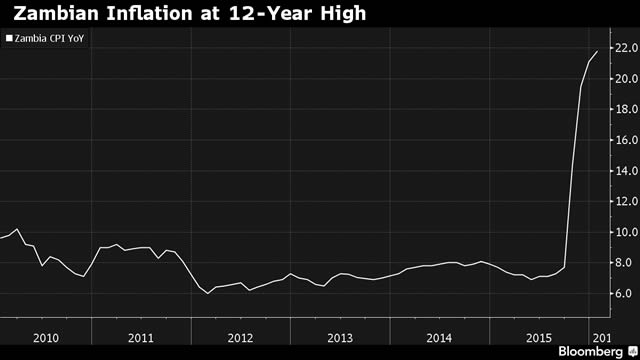
COMMENT - The problem is deeper than incompetence or a failure to listen. It goes right to the corruption that flows from the World Bank and IMF system like a tsunami. The former Finance Minister Caleb Fundanga's MEMFI institute now works with
the World Bank, IMF, Bank of International Settlements, and the National Treasury of South Africa. He is presently located in Zimbabwe, a country he disparaged for it's economic policies.
See:
(LUSAKATIMES) Fundanga opposed to suggestions to adopt the US dollar as national currency
September 4, 2015
The simple fact is this: as long as the mines are in private hands, the politicians will be bought off by the De Beers/IMF/World Bank cartel.
(THE POST ZM) Government officials now have kwacha diarrhoea - Nawakwi
By Mukosha Funga |
Updated: 06 Sep,2015 ,07:00:18
GOVERNMENT officials now have diarrhoea over the fast depreciating kwacha because of failure to heed to advice early on, says FDD leader Edith Nawakwi. And Nawakwi has charged that Zambia has a sleeping government. Meanwhile, Nawakwi has warned that Zambians will sit on the runway to prevent President Edgar Lungu from landing if he misuses public funds for party functions while in New York.
Nawakwi has over the last four years been calling for the dismissal of finance minister Alexander Chikwanda, saying he is ‘incompetent’. On March 18, Nawakwi attributed the continued depreciation of the kwacha to lack of economic understanding by President Lungu and his ministers and warned that the local currency would one day reach K15 to a dollar.
But government officials dismissed her statement as mere politicking.
However, six months on, the kwacha has breached the K10 psychological barrier,
trading at an average rate of K9.90 and K10.05 for buying and selling on Friday.
In an interview yesterday, Nawakwi said the kwacha has depreciated rapidly because of the government’s failure to listen to advice.
“When I said the dollar will reach K15, they were telling me that I was sick. Now I want to know who has diarrhea. Is it me or them? They were saying ‘Nawakwi is sick, she is politicking’; now let them talk. Instead of discussing the problem, they are playing golf. We told them [that] this Minister of Finance is going to take this country to the knife edge bridge. I haven’t even closed my mouth, where is the Minister of Finance? Where is he hiding?” she asked.
“They have been accusing me of politicking, so now I will start politicking. When I am advising them professionally, they don’t want to listen, someone is snoring and sleeping. Mwebantu ba mu Zambia, twapapata fumeni mubebe aba bantu ati beme bambe ukwenda! (You people of Zambia, I plead with you to come out and tell these people to stand up and start walking).”
Nawakwi said it as said that Zambia had a sleeping government.
“The kwacha has gone over K10 and the Central Bank and the Minister of Finance are sleeping. When a currency has slid this much, normally, speculators tend to go in and purchase the kwacha by bringing in dollars, praying that in the next one week, it can change and they can make profits. This is the best time that anyone who has dollars would have wanted to bring the dollars into the banking system. Those who have dollars in the mattresses, in the market, this is the best time because they can see that from one dollar, they will get more than K10 because we have a sleeping government,” she said.
“They are just snoring and not thinking about what is going on. They are still maintaining this archaic law which we put up in the 1980s which said that because there was a shortage of dollars - in fact this was a Katele (Kalumba) law - that there should be a restriction on how much dollars you can take out and how much dollars you can deposit. That was the reason for that. There was a shortage of dollars, there was no money, now this man has gone and borrowed Eurobonds which we can’t even see. Can they stop sleeping and take out the blankets from their heads and start to think! Stop playing golf! This is not time for golfing, sleeping and fundraising. This is the time for serious economic reflection.”
Nawakwi said not even diverting the US$120 million of borrowed money into the market could save the kwacha.
“I am asking [Bank of Zambia Governor] Dr Denny Kalyalya to lift this administrative hindrance where there is a restriction on deposit of dollars because that’s the only way we can mop up the dollars which are in mattresses and help the kwacha. It is not just by him releasing the few [dollars] which the minister borrowed a couple of months ago,” she said.
“I want them to answer me. I want those people who were saying ‘Nawakwi shut up’ to start talking now. I am urging them to open their mouths now. Talk baba, talk! Talk time yaoneka, talk! What is happening to the kwacha? We told them, even if it is a global phenomenon, it can be mitigated if you don’t have a deficit, the one that they have. This phenomenon of the sliding kwacha is being accelerated by the excessive expenditure, over borrowing and lack of alternative sources of income.”
Nawakwi said the argument that what was happening to the kwacha was a global phenomenon could not hold as the depreciation of other currencies was not as bad.
“Don’t tell me that because my neighbour is walking naked, I should also walk naked. That is wrong thinking! Because Tanzania has the same problem but they are not as hard hit as we are in this country. I wish I could be given a chance to talk to this Cabinet because it appears that the whole Cabinet is asleep,” she charged.
Nawakwi said the current massive load-shedding was worsening the economic situation.
“These people shock me; they are telling us we had a drought, isn’t this the same government which was telling us that we could not take ballot papers because of the heavy rains and the results could not come on time? They had to airlift the ballot boxes. Even the Minister of Agriculture said we have a bumper harvest because we had good rains. Now all of a sudden, in six months, they want to tell us there was a drought?” she wondered.
“How can you tell me, a Zambian who comes from Luapula, that we have a drought in this country? Does Egypt have dams? Does it have rainfall? In Egypt, does the Nile have waterfalls like we have here? The Nile is shared by so many states, fighting for the little water. Have you ever seen in Egypt where they cannot pick ballot boxes because there is too much rainfall? The answer is a simple no. They have a desert, one river and they have more power than this country where we have too much water.”
Nawakwi said the country lacked leaders with functioning brains.
“Ukutuka Lesa tuleke. Lesa alitulambula, alitupela fyonse efyo tufwayika. Efyo ta twakwata fye ni abantu abakwete ama tompwe ayaleshinguluka bwino muma office abo twapele inchito ati bane twafwilisheni. Pantu apa nafishupa. Ifilechitika lelo, Kwacha epo yafika, ninshi malilo, elo wingalaya namukutamfya aka bola wemukulu ne chinkonto, takwaba iyo (We should stop insulting God. God has blessed us with everything we need. What we lack are people with functioning brains in public offices who we have empowered to govern on our behalf. Because things are dire, what is happening today, how the kwacha has depreciated, amounts to a funeral. Is this the time a grown man should go and have the pleasure of playing golf, it is unacceptable),” she said.
Nawakwi also wondered why President Lungu could spend so much public money on campaigns but fail to pay the debt owed to the University of Zambia.
“There are 105 districts in this country; I am shocked that when we have no medicine, we have no books, the university can’t be paid but the President can buy 150 Land Cruisers purportedly for DCs when in fact, he is positioning district commissioners to be shadow MPs. He is sending them to start campaigning on public expenditure. You know, this kind of looting, I don’t understand it. This problem at the University of Zambia, we owe University of Zambia as a country K320 million. Now in dollar terms today, it is just $32 million. I am ordering minister Chikwanda to release $32 million dollars at the current rate of K10 to a dollar because that will resolve the problem at UNZA. That money doesn’t even have value to those who are owed,” she said.
Meanwhile, Nawakwi warned that Zambians would sit on the runway to prevent President Lungu from landing if he misuses public funds for party functions while in New York, where he will attend the UN General Assembly.
“We are seeing adverts that there will be a ‘Meet the President’ dinner in New York. Is it a PF trip? Or is it a government of the Republic of Zambia trip? How is he going to get to New York? Is he using an ox-cart or what? If it is a PF trip, I don’t want the policemen from Zambia to go with him. I don’t want the security team to go with him. Let him use PF security and use a chartered plane paid for by Patriotic Front. Honestly, if he goes on government expense, tell him he will have consequences which will be too dire to even contemplate,” she said.
“There will be no runway to land here. We are going to sit on the runway, he has to find his own runway. They should say that this is a private trip which he is paying for from his pocket since he has so much money now. But if he is going to New York just for fundraising for his political party, I don’t think I am going to accept it.”
Nawakwi said Zambians were the PF’s opposition in the 2016 elections.
“Anyway, he (President Lungu) has made our work very easy because in this country, this government of Patriotic Front doesn’t even need opposition. The people themselves are the opposition. They are feeling the heat, the people are angry; just walk into any shop, the problem is that this President can’t even go where we go. I am just walking downtown here in Cairo Road and he can come to Cairo Road and listen...he doesn’t even want to go on Cairo Road because he has created the dirtiest city in Southern Africa, but he is breathing fresh air there [at State House], playing golf,” said Nawakwi.
Related Stories
- See more at: http://www.postzambia.com/news.php?id=11099#sthash.HB4z1yyN.dpuf
Labels: ALEXANDER CHIKWANDA, CORRUPTION, DEBT, EDITH NAWAKWI, EUROBOND, IMF, KWACHA
Read more...
COMMENT - This is how they're softening up the economy for HIPC II. They should be in jail for fraud. And then there are the eurobonds, and the
SI89 tax rebate to the mines. External factors - only if the Minister is talking about the IMF/World Bank. Fluctuation in copper prices can be protected against. However this is a government that is trying to paper over state mishandling of resources and corruption, with Eurobond debt loans. This is onerous debt and must not be repaid. Without
massive legal and government reform, especially
financially, Eurobonds are just more sources for corruption. - MrK
(LUSAKATIMES) Current Economic Challenges facing Zambia are not unusual-Chikwanda
September 3, 2015
Finance Minister Alexander Chikwanda says the current economic challenges facing Zambia are not unusual. Mr Chikwanda said this is not the first time that Zambia is undergoing economic challenges caused purely by external forces. Mr Chikwanda said the dip in the economy is a normal cycle in any economic which should not be over dramatised.
He said the slowdown in the Chinese economy is mainly responsible for the weakening of the Kwacha as copper receipts have drastically reduced.
The Finance Minister was speaking in Lusaka on Thursday when he delivered a key note address at the 2015 Zambia Finance and Investment Conference organised by Euromoney Conferences at the Taj Pamodzi Hotel.
Mr Chikwanda said although some people want to portray a picture as if the government is solely to blame for the current economic woes, every genuine economist knew that there will come a time when the Chinese economy will begin to slowdown.
“Surely nobody expected China to continue growing at the same level, there was going to be a time when they would finish constructing their roads, office buildings and any other infrastructure and reduce their appetite for our copper and maybe that time has now come,” Mr Chikwanda said.
He said the Zambian economy is resilient enough to withstand the current economic storm.
Mr Chikwanda said government has taken a raft of measures to stabilise the macroeconomic environment which is necessary for sustainable growth.
He said government is focused on reducing the budget deficit to manageable levels as a free of freeing up capital for private sector lending.
“We are going to rein in on public expenditure this year and going forward as a way of managing our cash flow position, but most of these measures have to be taken before cabinet first, i normally do not like to pre-empt these tins before we debate them as cabinet but we are formulating something,” he said.
On the foreign exchange position, Mr Chikwanda said the Kwacha depreciation has been compounded by the speculators who are trying to cash in on the situation.
“The Bank of Zambia has been carrying out open market operations which have somewhat helped but they can only do so much and their activities have been restricted because of dwindling foreign exchange reserves, we are probably sitting around two and half months of import cover which is not a desirable situation.”
Related News: Labels: ALEXANDER CHIKWANDA, CORRUPTION, EUROBOND, NEOLIBERALISM
Read more...
COMMENT - There would be no debt at all if the government simply collected stiff Windfall Taxes from the mines. The debt is doubling, the currency is under pressure instead of increasing because of all the value flowing into the Zambian economy out of the mining sector.
Who is the lunatic now, Finance Minister Chikwanda?
Zambia’s future bleak due to incessant govt borrowing - Haabazoka By Misheck Wangwe and Stuart Lisulo | Updated: 26 Jul,2015 ,11:22:25
THE future of Zambia is bleak looking at the incessant borrowing being made by the PF government, says Copperbelt-based economist Dr Lubinda Haabazoka.
The Zambian government on Thursday issued a US$1.25 billion Eurobond, the highest ever, to be repaid in 10 years.
The facility, which was over-subscribed by US$500 million, is the third that Zambia has issued under the PF regime, at 9.37 per cent interest annually.
But Dr Haabazoka, who is also a senior lecturer of business studies at the Copperbelt University, said looking at the expenditure by allocation, much of the borrowed money might even go to consumption.
“No country in the history of economic development has ever developed on borrowed funds. One might argue that governments issue treasury bonds to develop their economies but the type of borrowing that we have seen is unprecedented. In 2011, Zambia only owed US$1.2 billion in foreign debt and now it owes more than US$7 billion. The rate at which we are acquiring debt is very high,” he said.
Dr Haabazoka said what was more worrying was that the sources of income were narrowing and the country’s economy was being run on borrowed funds.
He said the government could have cut down unnecessary expenditure such as scaling down the size of government and doing away with projects of low priority.
Dr Haabazoka said thinking that borrowed money was the only source of the national budget or running government was a misplaced ideology.
“This year is going to be the worst economically, after 15 years, because of the huge budget deficit due to lack of proper planning on the way government is supposed to be run. Look at the energy crisis! It will cost businesses because Zesco and government have recorded huge losses in terms of missed revenues and opportunities. Look at the fuel sector! There are huge losses; Indeni has shut and businesses that depend on generators to backup their energy sources have huge challenges to operate. Economically, our performance is dismal as a nation,” Dr Haazoka said.
He said the state of the economy was making it extremely difficult to operate smaller businesses.
“My advice to finance minister Alexander Chikwanda is that he must make this loan his final for the next two years. Those working in government must help in coming up with a strategy on how revenue collection could be improved without burdening the already overburdened labour force and formal sector,” Dr Haabazoka said.
He said the proceeds from the Eurobond were not likely to benefit Zambia’s economy owing to the massive externalisation of financial resources in the construction sector among foreign contractors.
“I see a lot of externalisation of resources because most contractors that are going to work on these infrastructure developments are Chinese and other foreign nationals so we are basically borrowing for foreign economic participants,” Dr Haabazoka added.
He also said the government’s intention to address the widening budget deficit, which is projected to soar to around K20 billion from K8.5 billion by accumulating new debt, will actually widen it even further next year.
“In trying to solve a budget deficit by borrowing, we are actually creating a wider deficit for the next year so basically, we are not solving anything! The easiest way to solve a budget deficit is to reduce unnecessary expenditure. You have to prioritise which sectors need money most and which ones can wait for the future,” said Dr Haabazoka.
- See more at: http://www.postzambia.com/news.php?id=9995#sthash.QdS8Zj5Q.dpuf
Labels: ALEXANDER CHIKWANDA, DEBT, EUROBOND, LUBINDA HAABAZOKA, NEOLIBERALISM, PF, WINDFALL TAX
Read more...
'Zambians' participation in economy glaringly absent'
By Misheck Wangwe
Thu 06 Feb. 2014, 14:00 CAT
ALEXANDER Chikwanda says the participation of Zambians in the economy is glaringly absent, largely on account of there being no institutions of development of various entrepreneurs that can turn to capital requirements.
And Chikwanda, who is finance minister minister and currently acting president, says President Michael Sata is in control of the country and in full command of the PF development agenda aimed at mitigating the levels of poverty among the citizenry.
Speaking when he opened the Natsave Lumwana branch yesterday, Chikwanda said the government was capitalising the bank so that it could modernise and have adequate resources to lend at reasonable rates.
And Bank of Zambia Governor Dr Michael Gondwe said there was increasing paradigm shift in consumer behaviour facilitated by developments in information technology and communication sectors.
"A survey conducted in 2009 established that only 37 per cent of the population uses formal and informal financial services, while 63 per cent are financially excluded. This is due to lack of physical access to financial service providers. It is important that financial institutions strive to bring financial services close to the public," Dr Gondwe said.
And NATSAVE managing director Cephas Chabu said the bank would continue to offer the required financial solutions to rural populations in the country.
Meanwhile, Chikwanda told Patriotic Front told Patriotic Front officials who attended the opening of the Natsave branch that useless squabbles among some party officials should not be allowed to divide the ruling party.
Chikwanda said with the PF, the country's interests would always be bigger than any individual's interests.
He said everyone in the PF must set an example of selflessness and tolerant leadership.
"If we become a party driven by useless squabbles and divisions, we are not going to attract anyone from other parties to join us. What will be the attraction? What will be the incentive or the purpose of other people joining us if you are always quarreling? Your responsibility is to guide our people in development tasks. We want you to show leadership," Chikwanda said.
He said President Sata's desire was to have party officials that would discuss issues in an honest manner and settle all differences amicably.
"You must learn how to maximise tolerance and accommodation of each other's opinion. People will always have differences. Even if you belong to the same mother and father, it's normal to differ, but what is important is to resolve those differences. Party officials, I want you to know that these things called affection, loyalty and respect are a reciprocal; if you don't respect people, they will not respect you and if you don't love people; they will not love you," Chikwanda said.
Labels: ALEXANDER CHIKWANDA, BOZ, CEPHAS CHABU, MICHAEL GONDWE, NATSAVE
Read more...
Our challenges in education
By Editor
Wed 05 Feb. 2014, 14:00 CAT
Finance minister Alexander Chikwanda says Zambia has remained stagnant due to weak investment in education.
And Chikwanda urges that "We should not gloss over the challenges that we have in the sphere of education. There is no other way any society can go forward without commensurate investment in education. Education is the only way through which societies enhance productive capacities of their nationals." We agree.
Our country's position in the emerging world of globally interconnected economies will doubtlessly be dictated by how successful it is in overcoming the severe limitations of its educational system, which is the foundation of sustained development.
Our country's future depends on the educational advancement of its people. Despite heavy expenditure on the sector over the decades, the rules of the system have proved to be significant hurdles to improvement. The system remains non-adaptive.
Achieving constructive improvement in our educational system will certainly be a cumbersome task. And this will require all our educated people to take up the cause of those who desperately need an efficient education system.
Education is one of the main factors that determine our attitude. As in the case of having a meal, it is not how much you consume that matters but how much you digest and use. In reality, we have knowledge and wisdom in information, but the thirst remains. A good education system ought to teach us not only how to make a living but also how to make a healthy livelihood.
Allocations of public spending on education have to be channelled properly. There is need for some revolutionary thinking on how to optimise the allocation in a proper manner.
The growing economy of Zambia needs a large number of citizens with a range of professional skills. The system should be able to ensure their employability. To achieve a proper blend of skilled people, vocational education has to be accorded utmost attention. The number of vocational institutions will need to grow.
The remarkable economic success of the Asian tigers has long fascinated the world. But how did the Asian tigers become an economic success story? This question warrants an overview of public policies that facilitate their fast and sustained economic growth. Initially, the policies and economic plans adopted by the Asian tigers were not much different from the policies and plans pursued by Zambia.
For example, South Korea started its journey towards economic takeoff with import substitution. But then the roads diverged. The Asian tigers sustained their economic growth at least for three decades since their takeoff in the 1960s, whereas our economic growth preceded in fits and starts. The Asian tigers witnessed, on average, more than a seven per cent growth rate between 1960 and 1990. In 1990, their share in the economy of the developing world was almost 34 per cent.
Several explanations have been put forth for the unprecedented economic growth of these countries.
The education and human development indicators of these countries were much higher compared to other developing countries even prior to their economic takeoff. Distribution of land and income was comparatively more equitable due to early land reforms.
The argument goes that the economic miracle of the Asian tigers was mainly due to their initial conditions. Skilled workforce and comparatively equitable distribution of resources provided an impetus to the growth process.
Politico-strategic factors are also cited as an explanation for the Asian economic miracle. First, the United States provided support to South Korea and Taiwan due to its geopolitical interest in the region. Second, Korea, Taiwan and Singapore enjoyed a great deal of political freedom to deal with rent-seeking preferences of the bureaucrats and other vested groups due to the authoritarian regimes in these countries.
Park Chung-hee in Korea and Chiang Kai-shek in Taiwan are particularly credited with steering these countries out of poverty and putting them on the path of sustainable growth. Third, timely land reforms in South Korea and Taiwan helped eliminate a potential source of opposition to industrial initiatives. Land reforms were also vital in the initial stages of development at least from these three angles.
First, land reforms increased rural productivity and income, increasing domestic savings as a result. Second, higher incomes resulted in higher demand for goods. This was needed before finding demand for goods in the outside world in the form of exports. Third, redistribution of income contributed to political stability, an important factor in creating an environment for domestic and foreign investment.
The third broad explanation for the economic success of the Asian tigers is the proactive role of the state in economic development. The governments of these countries made liberal use of industrial policies. They invested in ports, transportation and telecommunication. For example, Singapore focused on an adequate supply of electricity and on developing an effective telecommunications system that proved instrumental in making it a financial hub.
The governments of these countries created markets rather than depressing them. For example, postal saving banks were created to channelise domestic savings, and development banks were established for the rationing of credit on the basis of well-defined and transparent parameters.
Priority industries were given preferential access to capital, credit and foreign exchange. The governments also provided subsidies, such as provision of credit at lower interest rate, to the favoured industries. Governments actively encouraged firms to export. Exports provided a performance-based criterion for allocating credit, encouraged the adoption of international standards, and accelerated the diffusion of technology. Contests among exporters were widely used as incentive devices.
Now the question is: what lessons can we learn from the development stories of the Asian tigers? First of all, we need to appreciate that much of their focus was on development of human resources by investing in education and training of their people. For example, in South Korea, the expenditure per student at the primary level increased by 355 per cent (in real terms) from 1970 to 1989, whereas in our case, it was declining during the same period. We need to realise that our people are our real assets. The youth bulge can become our competitive advantage if we invest in human resource. Unfortunately, our public spending on education, training and health of the people is relatively still very low.
Equitable distribution of resources and incomes, on the pattern of the Asian tigers, is a must for political stability. In our case, gaps have widened with the passage of time. Wide economic and social disparities can never result in sustainable growth.
To follow in the footsteps of the Asian tigers, we need to invest more in education and training. Education is a vital component of any society. As Thomas Jefferson wrote: "If a nation expects to be ignorant and free, in a state of civilisation, it expects what never was and never shall be."
Labels: ALEXANDER CHIKWANDA, EDUCATION
Read more...
Zambia a country of functional illiterates, says Chikwanda
By Chiwoyu Sinyangwe
Sun 02 Feb. 2014, 14:00 CAT
ZAMBIA is a country of functional illiterates, says finance minister Alexander Chikwanda. Officiating at the launch of the revised edition of late John Mwanakatwe's book "The growth of education in Zambia since independence", Chikwanda said the country remained stagnant due to weak investment in education.
"We should not gloss over the challenges that we have in the sphere of education," Chikwanda, who is acting Republican President said. "Zambia, to some extent, appears to be a functional illiterate country. The readership is very low."
Chikwanda, who served in various ministerial positions in the UNIP regime in the 1970s, explained that Zambia lagged behind countries like South Korea which had smaller economies over 40 years due to lack of investment in education.
"There is no other way any society can go forward without commensurate investment in education," he said. "Education is the only way through which society enhances productive capacities of their nationals."
Chikwanda eulogised Mwanakatwe for his decision to document Zambia's education history at the time when it was unfashionable to rise outside the structure of the one party system of UNIP.
"It was not common practice to make reference to what people did because the one party system had its own internal logic that power was indivisible and so we tended to glorify the individual leaders and a few cronies around him," he said. "But we never sufficiently acknowledged what other citizens were doing, especially people in the education field. Mr Mwanakatwe was a unique role model."
Chikwanda blamed Zambia's underdevelopment on attitudes of citizens who were reluctant to render national service.
"...because Zambia has a very strange culture and I am happy that the secretary general Wynter Kabimba of our party is here so that he can infuse this in our party programme," said Chikwanda.
"In Zambia, people
have only rights and privileges but have no obligations, no responsibilities or duties. And that culture has evolved right from the inception of independence. Let's have a country where people, apart from having their lavish privileges and especially the lavish right to be ignorant and irresponsible...let's blend this culture with the sense of civic duty; the sense of responsibility and an obligation to our country and especially posterity."
At the same function, former education permanent secretary Dr Sichalwe Kasanda said Mwanakatwe laid the foundation of research and writing books in Zambia.
Dr Kasanda said after Mwanakatwe's publication in 1968, there had not been any new publication cataloguing the development of education in Zambia, post independence.
The last three paragraphs of the extended version of Mwanakatwe's book had been written by Dr Kasanda.
And Zamtel managing director Dr Mupanga Mwanakatwe eulogized his father who was a teacher, lawyer and politician.
Dr Mwanakatwe said the family decided to revise and launch the extended version of the book which had become a standard textbook for undergraduate students at the University of Zambia's School of Education and those involved in post-graduate studies on the evolution and management of education in Zambia.
Labels: ALEXANDER CHIKWANDA, EDUCATION
Read more...
(STICKY) Chikwanda wants govt to pay mines $600m in VAT refunds
Edited by Chiwoyu Sinyangwe
COMMENT - So the state borrows $1 billion through a Eurobond, and they don't know what to do with it? And they have the gall to say we need another Eurobond, because 'we need something for agriculture'? If they ran out of ideas, I have few ideas that not only spend the money well, but would create massive returns to the state - a concept that seems to elude the present government. And no, I don't trust the UPND, let alone the MMD who had 20 years to develop the economy. Giving borrowed money to the mines! Outrageous. - MrK
FINANCE minister Alexander Chikwanda wants the government to pay mining companies the disputed US$600 million (about K3.6 billion) in value-added tax repayments over a staggered period.
ZRA has withheld over US$600 million in value-added tax repayments to mining companies that have failed to provide importer documentation required to qualify them for VAT reclaim on the zero-rated copper exports.
“The minister [Chikwanda] says our current fiscal space is severely constrained for us to refund these mining companies of their VAT but that we can only clear the huge backlog by negotiating staggered repayments with the mining companies after we have instituted a more prompt VAT refunds regime,” according to the sources within Ministry of Finance.
The sources said the government currently did not have sufficient funds to offset the VAT refunds being claimed by mining companies.
“The minister says the only way for the government to clear this backlog promptly is to allow Treasury access some funds from the recently-acquired US$1 billion which currently was ‘sitting’ at the Bank of Zambia. Of that US$1billion Eurobond, only US$300 million has been disbursed so far and remaining the US$700 million is still with the Central Bank.”
The sources also said that Chikwanda contended that VAT General Administration Rule Number 18, which required ZRA to obtain information from importers outside Zambia’s jurisdiction had proved impractical and was blamed for delayed processing of VAT refunds for the mines.
VAT Rule 18 was aimed at assisting the government collect more accurate trade statistics.
In line with VAT general administration Rule Number 18, for any exporter to qualify for VAT zero rating of its exported goods, they must satisfy requirement which included copies of export documents for the goods bearing a certificate of shipment provided by ZRA, copies of import documents for the goods bearing a certificate of importation into the country of destination provided by the customs authority of that country.
Rule Number 18 also required exporters to provide proof of payments by the customer for the goods, tax invoices for the goods exported, documentary evidence, proving that payment for the goods has been made by the customer into the exporter’s bank account in Zambia [as introduced in January 2013], and such other documentary evidence that might reasonably be required by the authority.
But according to sources, Chikwanda had proposed that ZRA should amend Rule Number 18 to limit it to regulation and verification of exports and bank certification of receipt export proceed in order to clear the uncertainty and restore the confidence in the economy that was undermined by adjustment to Rule 18.
Last year, the government streamlined administration of the VAT refunds for the mining sector which included introducing rules requiring provision of documents from importers of copper to authenticate the final destination of copper being exported out of Zambia and the export revenue needed to be paid directly to a Zambian bank although some mining companies were paid through foreign accounts.
Konkola Copper Mines (KCM) has taken ZRA to the Lusaka High Court over a K3.2 billion tax bill relating to a retrospective 16 per cent VAT charge on exports from January 2011 to March 2013.
Some companies, including those in the mining sector, found to be complying with Rule Number 18 include KCM, Mopani Copper Mines and Zambezi Portland.
“The problem is that some mining companies and even other exporting companies allude that ‘they sell their products mostly to international traders who take ownership of the product either at the mine/factory gate or as soon as they are put in a ship at Dar es Salaam, Dubai or Durban,” the sources within ZRA said. “For purposes of VAT, a sale at the mine/factory gate is a local sale and should therefore be standard rated sale at 16 per cent of the sale and not zero-rated.”
Labels: ALEXANDER CHIKWANDA, CORRUPTION, EURBONDS, MINING, TAX EVASION, TAXATION, ZRA
Read more...
Chikwanda misleading Sata on debt - Nawakwi
By Henry Sinyangwe
Fri 24 Jan. 2014, 14:01 CAT
EDITH Nawakwi says finance minster Alexander Chikwanda is misleading President Michael Sata on debt sustainability following the government's path of 'reckless' borrowing. And Nawakwi who is FDD leader says the country is experiencing the worst farming season since independence owing to the late delivery of inputs.
In an interview following Chikwanda's statement during ZNBC's Sunday Interview that Zambia will not slide back into a debt trap, Nawakwi said Zambia's debt would be unsustainable if the government continues on the binge of borrowing from the commercial window.
"When they took over government about two years ago, the total debt was US$1.7 billion, as we are talking now, the debt is over US$3.5 billion and they are planning to borrow an addition of US$4 billion in the next two to three years. Then you add all these figures, the amount of debt that the PF will accumulate on behalf of this country by the end of their first term will be over US$8.2 billion, far much more than what the people of Zambia tightened their belts for and managed to clear in the 27 years of UNIP government," she said.
Nawakwi said the government should explain where it would get the money to service the debts.
"If the President today assures us that the debt is sustainable, the question he must answer is; where is the income that is going to service the debt, because the private sector is not growing, the trade sector has been strangled by the introduction of exchange controls, the international reserves are at their lowest in the last two years," she said.
Nawakwi said there were policy inconsistencies in the economy that had sent a wave of scare to the business community.
"The business community is in limbo and doesn't know what next this government is going to introduce," she said.
Nawakwi also said the agriculture sector was also being mishandled.
"If the President is saying to us that the budget is on track, can I be told why there is no urea in Chongwe. This is end of January and these are some of the policy inconsistencies which instead of generating cash from the agriculture sector, from the industrial sector, from the trade sector, these sectors are being strangled because the President doesn't want to face reality of our advice that this minister Chikwanda needs to be assisted to rest," she said.
Nawakwi said there was fear of hunger next year because the agriculture sector was not being properly run.
"And if you don't finance agriculture, you are going to have hunger the following year, you need money to import food to be able to feed people. Proper financing in the agriculture sector can help the government achieve even a 12 per cent growth in one year. Get half of the money that these people are overpricing in the road contracts and put it in agriculture, we could have surplus food for export and the money earned can be used for infrastructure development," she said.
"There is no malice in telling people that you are strangling our economy, and that's what they have done. What minister Chikwanda has created by the Statutory Instrument which is basically for control of foreign exchange, he has created a huge parallel market for the dollars, can the minister come out in the open and tell us why there is shortage of foreign currency in the system?"
Nawakwi said there was no government that did not borrow for infrastructure development, but that the current borrowing was unstructured and unregulated.
"We are happy about having a bridge in Chiawa, we are happy about having a road, we would even be happier if this government could realise that the same money they are using for the roads, they could finance the farmers and the profits from the farmers could be used to finance the roads. But what seems to happen is that they have a one track mind, they don't have the overview of what they can do as a government to generate money and also continue to undertake the infrastructure development," she said. "And that's why we are saying the debt is unsustainable because they are not able to finance education, health and agriculture."
And Nawakwi alleged that the government was getting funds from the parastatals because it had run broke.
"The President is aware that the money we sent to Zambia Railways was collected back, the President should be aware that all the money that was sent to parastatals for various projects, the minister went and got it back because he burst the budget. So when you stand up and mislead the President, we all get baffled. Maybe the President wants to be misled, because ideally I wouldn't come to the defence of the Minister of Finance because the activities are not pleasing anyone," said Nawakwi.
Chikwanda, during the interview, also wondered why Zambians believed the International Monetary Fund more than their own government on the country's economic status.
Chikwanda said the government was not worried about issues to do with debt management because everything was on the right track.
And President Sata on Sunday posted on his Facebook page that the country's risk of external debt distress remained low as all debt indicators were below the indicative policy thresholds.
President Sata assured Zambians that the government was cautious about landing the country into another debt trap.
Labels: ALEXANDER CHIKWANDA, DEBT, EDITH NAWAKWI
Read more...
Anyone can aspire for my job including schoolboys, Chikwanda
By Chiwoyu Sinyangwe
Wed 22 Jan. 2014, 14:02 CAT
EVEN schoolboys have the right to aspire for my job if they feel I am not doing well, says Finance Minister Alexander Chikwanda.
Addressing journalists on the state of the Zambian economy on Monday afternoon, Chikwanda said being finance minister was "absolutely burdensome".
"As Zambians, even schoolboys who think 'this bloody minister is not doing well', they have the right to aspire for this job," he said.
"This is a public job; it's not a personal to holder but I have some experiences.
You my countrymen have given me the opportunity in the past…I am a trained economist. When I left government, there was a stampede for me to join this and that but I couldn't join all the boards. So, I have some experience in the public and private sector. And when the President Sata asked me to help, I willingly agreed. But for me, this job is not a matter of life and death. It is absolutely burdensome. I accepted the ordeal because our country needs dedicated efforts. Operating from here, I can see disheartening lack of commitment and lack of seriousness…"
Chikwanda said being at the helm of the country's Treasury needed someone with energy.
"I volunteered to help and when it's expedient and opportune, I am quite prepared to bow out and I am sure if there are any young men and women who would like to take up this job, I am quite prepared to give them an appropriate brief…maybe they can do well," he said.
"You need people with blood in these jobs. I can't be there indefinitely ….when you reach certain age, we are essentially in the 'departure lounge'. I am just there out of total commitment and devotion to work for my country. It's not a means of earning a living."
Chikwanda has in recent months come under attack from some key stakeholders, including former finance ministers Edith Nawakwi and Ng'andu Magande, on the flagging local economy and accused the former of arrogance and incompetence, among other inadequacies.
Labels: ALEXANDER CHIKWANDA
Read more...
(LUSAKATIMES) Ministry of Finance in wrong hands-Nawakwi
Time Posted: January 21, 2014 11:11 am
Forum for Democracy and Development (FDD) president Edith Nawakwi has charged that the ministry of Finance is currently in wrong hands.
Commenting on Finance Minister’s Alexander Chikwanda remarks that the country is within sustainable growth and there is no possibility of failing in another debt trap, Ms Nawakwi says she is worried because President Michael Sata will have to bare the brunt of the country’s economic mismanagement.
Ms.Nawakwi said that by the time the Patriotic Front leave office, the country would have accumulated about 8.2 billion dollars in borrowing due to reckless expenditures.
Ms Nawakwi stated that it is only fair for President Michael Sata to persuade Mr. Chikwanda to retire and take into consideration that he is not relevant to the economic aspirations of the country.
Ms. Nawakwi has also challenged the ministry of Finance through the central bank to tell the nation how much is in the foreign reserves.
[QFM]
Labels: ALEXANDER CHIKWANDA, EDITH NAWAKWI
Read more...
Zambia won't slide back into debt trap - Chikwanda
By Kabanda Chulu
Mon 20 Jan. 2014, 14:01 CAT
ZAMBIA will not slide back into a debt trap because President Michael Sata is a good economic manager who doesn't allow careless borrowing and excessive expenditure, says finance minister Alexander Chikwanda. And Chikwanda says people making assertions of his resignation are after his job.
Meanwhile, Chikwanda says the Industrial Development Corporation (IDC) is a reincarnation of ZIMCO that would be a holding company for all state-owned enterprises.
Chikwanda also wondered why Zambians believed the International Monetary Fund (IMF) more than their own government on the country's economic status.
He said the government was not worried about issues to do with debt management because everything was on the right path.
"2013 was a difficult year; there were lots of challenges but it also created opportunities for us to think and institute procedures and systems to effectively run the economy. The budget deficit ended at over eight per cent and one key factor was the increase in emoluments for public service workers, whose unions negotiated far above what was budgeted for and we gave in since we are a listening government," Chikwanda said during last night's Sunday Interview programme on ZNBC TV. "By-elections didn't contribute to the deficit since they are budgeted for and if the Electoral Commission exhausts what was planned, we do replenish their coffers. Even new districts are budgeted for, so those saying we lost focus and started appeasing people are wrong because President Sata is a good economic manager, who doesn't allow careless borrowing and excessive expenditure. Anyway, what is political about a school? What is political about procurement of fertiliser and medicines? We are committed fiscal discipline and we try to spend according to the budget. Of course, there are times when national priorities arise like the salary hikes for workers."
He said it was surprising that Zambians believed what the IMF says, rather than their own government.
The IMF has projected a 7.4 per cent budget deficit for Zambia, while the government has set it at six per cent.
"IMF doesn't run the economy and we have no programme with them. We are not borrowing from them, they are not the alpha and omega of truth because they are not adequately informed, especially when you just talk to an individual. Zambia is also IMF as a member and when a delegation comes into the country, we avail them all documents and they meet other stakeholders so IMF hasn't lost faith in this government; it is only one individual making his assessment," Chikwanda said.
He also said the government would not give in to demands by some people that the wage freeze be lifted.
Chikwanda said the government was committed to ensuring effective debt management systems.
"People are entitled to express their opinions but we listen attentively even to my predecessors. Last month, Dr Situmbeko Musokotwane made some valid remarks in Parliament and we noticed that what he said made sense but there are some former finance ministers who pour scorn on me for no apparent reason since they don't have details," he said. "We are not worried because we are doing the right thing on debt management. The agreed norm is that for internal borrowing the threshold is 25 per cent of GDP but our debt stands at K17 billion, which is 15 per cent of GDP and for external borrowing, the threshold is 40 per cent and our debt is US$3.1 billion which is 14 per cent of GDP, so we are far below the agreed norms."
Chikwanda said budget deficits should be discouraged because the government pays a lot on debt servicing.
"This is why we are putting in place measures to generate enough revenue so that we can avoid borrowing. Of course, some people are saying windfall taxes for the mines but that is a 'fetish' which some people want to hang on to whether it is logical or not. We do understand that contribution of the mining sector is very low at five per cent but we shouldn't just look at taxes; there are other factors like having the mines generating 70 per cent of foreign exchange and creating jobs," he said. "Ideally, we want to see the mines contributing about 10 per cent and ZRA is being strengthened to ensure efficient revenue collection."
Chikwanda said his mission in government was to serve the people and not to make money.
"I will step down when I decide; I am here for a purpose…to serve people. Poverty levels are too high and it is shameful, so we need to do something collectively. I am not here for money and I can't comment on the issue of resignation because I have never contemplated that issue. Some people have invented something which is not on my radar, not in my plans," he said. "Those saying that are after my job but they should know that I am not excited anymore; I have passed 75 years but I work not less than 13 hours a day, so I will leave at the right time. I was here in 1973 when I was 36 years old; I just want to serve the people."
Chikwanda also said the IDC was in the process of being established with funding from the privatisation trust fund and would be a holding company for parastatals to operate the way ZIMCO did.
Labels: ALEXANDER CHIKWANDA, DEBT
Read more...
UNZAWU calls for windfall taxes
By By Edwin Mbulo in Livingstone
Wed 01 Jan. 2014, 14:00 CAT
UNIVERSITY of Zambia and Allied Workers' Union has joined calls for the reintroduction of windfall tax on mines. Union president George Katapazi said Zambians are not benefiting much from the mines and the reintroduction of the windfall tax would change the tide.
Katapazi in an interview said the government was doing well on infrastructure development but that this was not backed by a broad revenue base.
Finance minister Alexander Chikwanda last week said the government cannot be dictated to by feelings coming from the streets on the issue of windfall tax. His comments followed widespread calls for the reintroduction of the windfall tax which was scrapped by Rupiah Banda's government in 2009.
The windfall tax, introduced in 2008 by Levy Mwanawasa's government, sought to raise not less than US$415 million annually during periods of high copper prices on the international market.
For copper, the windfall tax was pegged at 25 per cent at a price of US$2.50 per pound, but below US$3.00 per pound; 50 per cent for the next 50 cents increase in price and 75 per cent when prices are about US$3.50 per pound. Katapazi said with an increased revenue base through the reintroduction of the windfall tax, the government would be able to embark on other developmental projects apart from those already started.
"What the government has embarked on is great in terms of infrastructure development such as the roads, stadiums, schools, clinics, administrative offices for new districts and hospitals, but it needs a broad revenue base for new developmental projects," said Katapazi.
Labels: ALEXANDER CHIKWANDA, GEORGE KATAPAZI, UNZAWU, WINDFALL TAX
Read more...
Nawakwi questions govt borrowing
By Henry Sinyangwe
Sat 28 Dec. 2013, 14:01 CAT
FDD leader Edith Nawakwi has questioned the intention by government to borrow more money to finance the budget. Meanwhile, Nawakwi says 2014 will present hunger and inadequate funding to government departments.
Government next year intends to borrow K9.64 billion to finance part of the budget for 2014, which is about 22.6 per cent of the national budget. Government last November raised the country's debt external debt ceiling from K20 billion to K35 billion.
Nawakwi said President Michael Sata should get rid of Chikwanda to save the country from another calamity of a debt trap.
"Time has come for the honourable Minister of Finance Alexander Chikwanda to shift from his current position into retirement. I know that a lot of us don't like doing the honourable thing, that is to resign from one's position. So the President of this Republic must save this country from the impending calamity of pushing Zambia into another debt trap," Nawakwi said.
She said the World Bank and the IMF had lost confidence in the economic management of the country.
"Today's reading that they are worried is just a tip of the iceberg. The truth is IMF is headed back to set up camp in Lusaka in January 2014 because they do not believe that Chikwanda is managing our economy competently. This is coupled with his inability to listen to those of us who he terms 'street people' when we talk about his lack of knowledge on management of our fiscal regime in this country. There are 13 million of us in this country and for sure, we must have one child somewhere in the corners of Zambia who can serve this country with diligence, competence and direction," said Nawakwi, who once served as finance minister in the Frederick Chiluba era.
She said some ministers were arrogant.
"Early this year, I raised the alarm that the budget had burst, that the Minister of Finance was not in the frame of mind to be able to control the runaway expenditure. There was hue and cry from the ministry. They tried to justify their actions to the point where even the likes of labour minister Fackson Shamenda had to criticise my persona. I then still raise the alarm that by January 2014, IMF is setting up camp again in Zambia due to their lack of confidence in the management of our economy by the current Minister of Finance," Nawakwi said.
She said the country no longer required Chikwanda's services.
"If the President does not listen to this very serious and timely advice, he has himself to blame for what Zambia is going to be in the next three or four years. 2014, we will be faced with hunger; 2014, we will be faced with inadequate funding to departments and ministries. We have doctors and nurses on strike, the Minister of Finance is mute; we have no medicines in the hospitals, we have no mealie-meal in several places and the buck stops at the Ministry of Finance," Nawakwi said.
She said she did not understand why President Sata thought Chikwanda was the only Minister of Finance the country could have.
"If the President is not able to relieve him, I think my brother should be honourable enough to say he needs to rest and allow younger people to be able to assist this country," Nawakwi said.
"This is a person who wants to export copper ore, this is a person who doesn't care whether nurses are on strike, this is the nominated member of parliament who doesn't care about the state of the University of Zambia. Unless we clear the stumbling block at the Ministry of Finance, whether it is PF, FDD, UPND, we may dance and cry, the buck stops at the Ministry of Finance."
She also expressed worry that Chikwanda signed the SI allowing exports of copper concentrates without any charge, which was later reversed by President Sata.
"If my minister doesn't understand that gold and other precious minerals are not found in independent mines, they are by-products of copper concentrates and he wants to give it as a Christmas gift to some companies, what can we discus? We are simply sitting on a time bomb," Nawakwi said.
She said a lot was sacrificed to get Zambia's debt written off, hence the country could not sit and watch mismanagement of the economy in the name of PF and some ministers in government.
"The reason we are having so much ineptitude is due to the fact that some of these brothers are nominated MPs. You go to Ministry of Education, there is no progress, you got to finance, he tells us 'shut up, you are advising me from the streets on windfall tax', you go to Ministry of Agriculture, the gentleman doesn't even know when we should plant our seeds. You go to Ministry of Health, there are problems. You go to Ministry of Justice, you want to get the constitution on time, who does he report to? He has no constituency apart from number one the President," Nawakwi said.
She said the country was facing major problems because critical ministries were manned by people who had no constituencies.
"These nominated MPs are living in ivory towers and as far as I am concerned, my only advice to President Sata for 2014 is to get rid of this lot. Let him nominate women and see what they can do. Let's get a different direction for 2014 and that can only happen if we come to 2014 without my brother Chikwanda at the helm of our treasury," Nawakwi said.
She said Chikwanda must not take the country to the days when a head of state must start telling the nation to tighten belts.
"This is the time when we need to loosen our belts. If you are going to injure us in this way, we are going to fight. This is injury, especially for those of us who spent long hours, days negotiating with the international community to write off our debt," said Nawakwi.
"People like ABC have not experienced what it takes to negotiate a debt write-off, to camp in a foreign capital, begging. He has not experienced what late Cardinal Mazombwe experienced and many Zambians who fought to get the debt written off; that's why he is so arrogant."
Labels: ALEXANDER CHIKWANDA, DEBT, EDITH NAWAKWI, FDD, MICHAEL SATA
Read more...
(STICKY) Chikwanda on growth, poverty
By Editor
Sat 29 Mar. 2014, 14:00 CAT
COMMENT - If anyone is still impressed by neoliberal economics, I would suggest checking out two books:
Reclaiming Development, by prof. Ha-Joon Chang
23 Things They Don't Tell You About Capitalism, by prof. Ha-Joon Chang
- MrK
Finance minister Alexander Chikwanda says Zambia's current economic growth is not sufficient to reduce poverty. It is indisputable.
And despite what may be said to be "impressive economic growth" over the last decade, poverty levels are still high. Why? There is need to look at where this growth is coming from and where that growth is being consumed. Who is that growth really benefitting?
It is true that Zambia is lagging behind countries such as South Korea in reducing poverty despite the two nations' gross domestic product being at the same level at the time of our independence in 1964. As Chikwanda correctly observes, in 1964, Zambia's GDP stood at US$3 billion, while that of South Korea was US$3.8 billion. And currently, South Korea's GDP is 55 times higher than that of Zambia.
In 1961, eight years after the war with North Korea, South Korea's per capita income stood at US$82, less than half of Ghana's at the time (US$179). An internal USAID report in the 1950s described South Korea as a "bottomless pit". At the time, its main exports were tungsten, fish and other primary commodities. Today, South Korea is an industrial powerhouse, with per capita income in five digits.
It took the United Kingdom over two centuries - between the late 18th century and today - and the United States around one and half centuries (the 1860s to the present day) to achieve the same result. South Korea's progress is as if Malawi has turned into Switzerland.
General Park Chung-Hee, the father of South Korea's miracle, came to power in a military coup in 1961 and then went on to win three successive elections. Not democratic in the true sense of the word, Park propelled the country's success via Five Year Plans for Economic Development, which had a lot of indigenous economic empowerment schemes built into them. South Korea was developed by South Koreans.
Yes, they did everything possible to attract foreign investment but they were not totally dependent on it. They were more dependent on their own initiatives, on the contributions of their own people. The South Korean people were in the driving seat of their country's economic life. We are not. And very few in Africa are.
We are so dependent on the extractive industries in which we play no role. Even our government's role in it is very weak and in most cases, very easy to manipulate in terms of policy choices.
Variable foreign currencies were really the blood and sweat of South Korea's "industrial soldiers" fighting the export war in the country's factories. Those squandering foreign exchange on frivolous things, like illegal foreign cigarettes, were seen as traitors. Foreign travel was banned unless you had explicit government permission to do business or study abroad. The government took absolute control of the scarce foreign exchange, and violation of foreign exchange controls could be punished by death. Here in Zambia today, we are squandering the meagre foreign exchange we are earning in all sorts of ways. We do not have even ways of ensuring that whatever foreign exchange the country earns is accounted for. We have just removed very good statutory instruments - SI 33 and SI 55 - that were designed to maximise the country's use and benefits from its foreign exchange earnings. Pressure was mounted by foreign businesses and their local political agents and other representatives. Today in Zambia, one can export anything and keep the money abroad, bringing in only that which one needs to pay for local inputs. The SIs we have removed tried to mitigate that. But the government was being blackmailed - blackmail that resulted in the kwacha depreciating at a very fast rate.
How does a country like ours expect to develop when its important earnings are kept in other countries and for use by other countries? This is all being done in the name of economic liberalisation. This is not economic liberalisation, it is economic foolishness. Even the South Africans, with more money, a bigger economy than us, are not doing these senseless things we are doing. The rand was depreciating at some point but the South African government did not panic and allow itself to be blackmailed.
We should learn from South Korea. What South Korea actually did during these decades was to nurture certain new industries, selected by the government in consultation with the private sector, through all forms of government support until they "grew up" enough to withstand international competition.
The government owned all the banks, so it could direct the lifeblood of business - credit. Some big projects were undertaken directly by the state-owned enterprises. The government also took foreign investment under its wing, and heavily controlled it with a mixture of measures. In general, it welcomed foreign investment with open arms in certain sectors and shut it out completely in others, in line with the national plan at any one time.
And here comes the rub: the popular impression of South Korea as a free trade economy was created by its export success. But export success does not require free trade, as Japan and China have also shown.
Clearly, the South Korean economic miracle was a result of clever and pragmatic mixture of market incentives and state direction. We are where we are today because of our failure to come up with clever and pragmatic initiatives. We have allowed other people to see things for us, decide things for us, do things for us. If we think we can make progress this way, we are deceiving ourselves.
We are one of the easiest countries to manipulate. We get so excited with any little praise from foreign investors, the World Bank, the International Monetary Fund and other donors. We are more interested in what these people say about us than anything else. But look at what South Korea did! Does it fit in the paradigms that are being bandied around by the agents of neoliberalism whom we seem to respect and listen to so much?
The example of South Korea Chikwanda is giving is a very good one. But it is important not to just throw around figures or statistics but to truly understand the substance, and not just form, of what really went on there to give them the development they are enjoying today and they so much deserve.
Labels: ALEXANDER CHIKWANDA, NEOLIBERALISM, POVERTY
Read more...
Haabazoka urges Chikwanda not to dismiss windfall tax
By Kabanda Chulu
Sun 22 Dec. 2013, 14:01 CAT
DR Lubinda Haabazoka has urged finance minsiter Alexander chikwanda not to dismiss windfall tax. Disagreeing with Chikwanda's stance on windfall tax, Haabazoka said the government should not reject ideas on mining taxation because all citizens have a common goal to see national economic development.
Speaking to journalists on Friday, Chikwanda said the government's programmes, including the reintroduction of the mining windfall taxes, could not be dictated by the feelings coming from the streets.
When asked what the government's position was on renewed calls to re-introduce the windfall taxes, Chikwanda said people were right to complain that the country was not getting its fair share from the mining sector, but that the government, however, had its own programme.
"We can't just have our programmes dictated by the feeling on the street, enlightened or unenlightened," he said.
Chikwanda said the government had its own plans to revise the mining taxation, taking into account the interests of the country as well as ensuring that the mines operate viably.
"The government in this situation is like a dairy farmer; if you want milk from a cow, you don't do things which will kill the cow because you will have no milk. You would want to invest in your cow or cows..., up the nutritional requirements, so that you can get more milk and possibly over an extended lactation period," he said.
"So the government has to do a serious balancing act. We can't just wake up and slap, say, 20 per cent or 30 per cent royalty tax on a little mine which in no time will go under; and if you are a mine like KCM - you employ 20,000 people, you put people on the street...The assurance, however, I can give the people of Zambia is that the government is alive to the issues relating to tax in the mining industry.
But Dr Haabazoka, the Copperbelt University academician, said everyone was entitled to their own opinions.
"I disagree with the minister on windfall tax because there is nothing wrong for people to call for windfall tax and government should not reject ideas because all of us have one common goal to see national economic development, whether one is for windfall tax or not," he said.
"Windfall tax is key in maximising revenue collection from the mines since it will tax super profits and if the mines make losses, then there will be nothing to tax but as we explore this route, we should also bring sanity to the mining sector by addressing the way profits are calculated, exports are declared and how production is monitored.
This way, we shall get meaningful results. Also government should understand the cost structures of the mines as they come up with taxation policies because operations at KCM can be different from that obtaining at Muliashi in Luanshya."
In 2008, under Levy Mwanawasa, the government introduced a windfall tax on base metals at a minimum rate of 25 per cent with a revenue projection of at least US$415 million per annum.
For copper, the windfall tax was pegged at 25 per cent at a price of US$2.50 per pound but below US$3.00 per pound, 50 per cent for the next 50 cents increase in price and 75 per cent above US$3.50 per pound.
But Rupiah Banda's government removed the windfall tax, claiming that it was 'hurting' the mining investments. And following the election of the PF into government, pressure from the civil society mounted for the re-introduction of the windfall tax. However, Chikwanda in 2011 said those calling for the re-introduction of the windfall tax were 'lunatics'.
And on the International Monetary Fund (IMF) which raised concern over rising fiscal imbalances and lower reserve coverage, Dr Haabazoka, who is head of account and finance department in the School of Business at Copperbelt University, said the statement was timely and the government should move towards increasing reserves.
"The call by the IMF is valid, we need to build reserves by broadening the resource mobilisation, and actually, the culture of savings should not just be encouraged at homes but also at national level, we shouldn't just build two or three months import cover that is used on consumption," Dr Habazoka said.
"We shall have problems if not addressed because debt servicing is done in foreign currency, hence we need to create a stabilisation fund that can cushion unfavourable swings in copper prices or negative impacts in the global economy."
He also commended Chikwanda for proposing the wage freeze.
"Government is over-stretched and cannot afford to offer huge increments, especially that most public service workers got more than 100 per cent and these increments were not tallied to production but to removing imbalances and harmonisation of salaries; so the wage freeze will also help government to plan," said Dr Habazoka.
"And despite the proposed recruitment freeze on those directly on government pay roll, it doesn't mean government will not create employment but this will be done through the various infrastructure projects being undertaken countrywide."
Labels: ALEXANDER CHIKWANDA, LUBINDA HAABAZOKA, WINDFALL TAX
Read more...
Chikwanda rejects 'street dictation'
By Gift Chanda, Chiwoyu Sinyangwe and Kabanda Chulu
Sat 21 Dec. 2013, 14:01 CAT
*** COMMENT - More lies from the mines. The mines would collapse because the Windfall Tax would make them 120% of profits? On the other hand, if FQM's cash costs are higher than $2,50 per lbs (below which the windfall tax is 0%), I would like to see them prove it, because the Cash Cost per lbs at KCM is $1,00 (which would leave the next $1,50 of profit completely untaxed). Cash Cost at Katanga Mining is $1,69 per pound. But FQM claims that their Cash Costs are over $2,50 per pound? Let them prove it. - MrK
And another thing - the last time the IMF 'advised' Edith Nawakwi that 'copper prices would not rise in her lifetime', they were dead wrong. When do they pay for being wrong? When will people stop listening to the IMF's 'advice'? - MrK ***
FINANCE minister Alexander Chikwanda says government programmes, including reintroduction of the mining windfall tax, cannot be dictated by the feelings coming from the streets.
When asked what the government's position was on renewed calls to re-introduce the windfall taxes, Chikwanda yesterday said people were right to complain that the country was not getting its fair share from the mining sector.
"However, the government has its own programme," Chikwanda told journalists.
"We can't just have our programmes dictated by the feeling on the street, enlightened or unenlightened."
He said the government had its own plans to revise the mining taxation, taking into account the interests of the country as well as ensuring that the mines operate viably.
"The government in this situation is like a dairy farmer; if you want milk from a cow, you don't do things which will kill the cow because you will have no milk. You would want to invest in your cow or cows..., up the nutritional requirements, so that you can get more milk and possibly over an extended lactation period," he said.
"So the government has to do a serious balancing act. We can't just wake up and slap, say, 20 per cent or 30 per cent royalty tax on a little mine which in no time will go under; and if you are a mine like KCM - you employ 20,000 people, you put people on the street."
He said the government had a responsibility to ensure that jobs in the mining sector are secured.
"The assurance, however, I can give the people of Zambia is that the government is alive to the issues relating to tax in the mining industry.
In 2008, under Levy Mwanawasa, the government introduced a windfall tax on base metals at a minimum rate of 25 per cent with a revenue projection of at least US$415 million per annum.
For copper, the windfall tax was pegged at 25 per cent at a price of US$2.50 per pound but below US$3.00 per pound, 50 per cent for the next 50 cents increase in price and 75 per cent above US$3.50 per pound.
But Rupiah Banda's government removed the windfall tax, claiming that it was 'hurting' the mining investments. And following the election of the PF into government, pressure from the civil society mounted for the re-introduction of the windfall tax. However, Chikwanda in 2011 said those calling for the re-introduction of the windfall tax were 'lunatics'.
And the International Monetary Fund (IMF) says there is need for better enforcement of existing taxing laws for the mining sector.
IMF resident representative for Zambia Tobias Rasmussen said there was also need to maintain policy consistence and stable investment environment in the mining sector.
"The tax regime for the mining sector is fairly standard for the industry," Rasmussen told journalists yesterday. "What is needed is better enforcement of the existing legislation. So, we would advise you go that route than changing legislation."
Rasmussen said the contribution of the mining sector to the overall local economy of Zambia was projected to rise as mining companies ramp up output and new mining projects come on stream.
"We are projecting that there will be an increase in mining revenues in the coming years," said Rasmussen.
"The two important reasons for this is that there will be increased production and some significant expansion underway which will increase production levels and that will also enhance the taxes to government. So, that is the way to approach the need for higher revenues is that area."
Meanwhile, mining industry experts have advised the government to devise an effective taxation policy that would ensure that a fair share of mineral wealth is distributed to local people.
And Chamber of Mines representative Kingsley Chinkuli says reintroduction of the windfall tax regime will be detrimental to the mining sector.
During a discussion on mining taxes hosted by the Economics Association of Zambia in Lusaka, economist Professor Oliver Saasa said the mines were a key component in the development of Zambia and people expected it to play a bigger role beyond the current scenario.
"But the mines are relatively lower players in the economy. While we may accuse the mines of failing to contribute sufficiently, we have also failed to establish effective structures, for instance, Ministry of Mines, Bank of Zambia, Central Statistics and ZRA have different figures and if our tax revenue collection is based on profits, then government should have accurate figures," said Prof Saasa.
"Our capacity is very weak and we have not done well to strengthen institutions that should monitor and get realistic revenue. Even with the windfall taxes, very few paid. Most of them resisted but since we lack capacity, even when we realise that we have been shortchanged, we still lack capacity to change things, so we need to put our house in order to get a fair share."
Financial expert Gilbert Chinyama said there was need to have research-based debates relating to economic governance of the country.
"Research organisations and other think-tanks should carry out studies and make their findings available for people to make informed comments on matters of the economy including the issues of windfall taxes," he said.
University of Zambia School of Mines lecturer Mathew Mpande said there were many forms of taxing the mines.
"There should be a balance between what the mines want and what the community wants but the current system which is being applied to the tax the mines is profit based and this is prone to abuse through tax avoidance, evasion and transfer pricing," said Dr Mpande.
"In India, they apply the expenditure based. I think it is very fair and Zambia should also tax the mines through this system. For example, when you look at the trucks that haul copper concentrates from Kansanshi to the smelters in Chingola, you realise that these are modern fleets of trucks, so tax the mines based on the expenditure they are making."
And Gen Chinkuli, who is also First Quantum Minerals country manager, said mines would collapse if the windfall tax was brought back.
"Mere attacks based on ignorance will not help the situation. The windfall tax is not the answer. If re-introduced, overall taxes for the mines will stand at 120 per cent, so meaningful consultation is needed to come up with a win-win situation," he said.
"FQM currently pays mineral royalty at six per cent on revenue, 30 per cent profit tax and 30 per cent variable tax also on profits. These are very high tax rates and if more taxes were to be added, then the mines will collapse."
Labels: ALEXANDER CHIKWANDA, GEN CHINKULI, LUBINDA HAABAZOKA, TOBIAS RASMUSSEN, WINDFALL TAX
Read more...
Chikwanda proposes single account for non-tax revenue
By Kabanda Chulu
Fri 06 Dec. 2013, 14:00 CAT
FINANCE minister Alexander Chikwanda has proposed that non-tax revenue collected by quasi-government institutions such as PACRA should be put in a consolidated account at Bank of Zambia to ensure transparency and accountability.
But there have been concerns that affected institutions would face operational challenges and might even fail to retain qualified staff if funding is delayed from the government.
Moving the motion to amend the Competition and Consumer Protection, the Environmental Management, the Fees and Fines, the Patents and Companies Registration Agency and the Weights and Measures Bills, Chikwanda said fees and any other revenue collected by these institutions should become part of the national treasury.
However, Committee on Legal Affairs, Gender and Child Matters chairperson Jack Mwiimbu said witnesses interviewed at the Competition and Consumer Protection Commission and the Zambia Environmental Management Agency said operations of the entities would be affected.
"Mr.chairman, your committee was told that their budget flows will be affected and operations will be stifled if the national treasury suffers budget deficit. For instance, ZEMA requires timely funding to carry out its work and previously, they faced problems when they relied on direct funding from government," said Mwiimbu.
"We are aware that these measures are aimed at enhancing revenue collection and will ensure greater sharing but there are concerns that delayed or reduced funding might result in withdrawal of certain incentives thereby forcing qualified personnel to leave."
But Chikwanda assured that funds would be placed in a dedicated account at BoZ that would be ring fenced and ready for use whenever an emergency arose in the concerned institution.
"Their operations will neither be affected nor compromised and before money is deposited into control-99, funds necessary for operation including emergency activities will be availed," he said.
And Committee on Delegated Legislation chairperson Moono Lubezhi said witnesses interviewed at Patents and Companies Registration Agency and Weights and Measures Agency, also said provision of efficient services would be affected due to delayed funding.
"They said that funding should be timely and adequate to ensure smooth operations," she said.
In response, Chikwanda said all funds would be put to good use.
"Operational costs of these institutions will not be affected, all we want is to ensure these funds become part of general revenue and should be accounted for," said Chikwanda.
Labels: ALEXANDER CHIKWANDA, PACRA, TAX EVASION, TAXATION
Read more...
Cost of bad governance
By Editor
Wed 20 Nov. 2013, 14:00 CAT
"Good governance should be a crusade for every Zambian," says finance minister Alexander Chikwanda. We agree. But it is easier said than done. Good governance is an idea which is difficult to achieve in its totality. However, to ensure sustainable human development, action must be taken to work towards this idea with the aim of making it a reality.
Good governance means many things. It means participation of both men and women in the governance of their country; obedience to rule of law; transparency - keeping to rules and regulations in the enforcement of decisions taken as well as making information freely available and directly accessible to those who will be affected by the decision and their enforcement; responsiveness - a good government must be able to respond or serve the people within a reasonable and actualisation time frame for easy assessment of the government in power; consensus-oriented because there are several actors as well as viewpoints in any given society; equity and inclusiveness to ensure that every stakeholder is carried along in every aspect of government and make them feel they have a stake in it and feel not maginalised; accountability is another element of good governance which has to do with rendering account of how material and human resources were distributed to different segments of society for the actualisation of the set goal; effectiveness and efficiency - a government is said to be effective and efficient when it can make use of the available resource, both human and material resource to meet the needs of the society.
In addition, where these qualities are present in a government, it can result in quality healthcare, wealth creation, food security, infrastructure development, employment generation as well as adequate national security and so on and so forth.
Furthermore, if these qualities are missing or non-existent in a government, it means that governance is bad and that it is engrossed in the twin evil of bribery and corruption, disobedience to rule of law, lack of accountability and others by plunging the people into insecurity, abject poverty, unemployment as well as poor state of infrastructure.
Clearly, good governance starts with honest leadership, incorruptible leadership. There cannot be good governance in a country or government where the leaders are corrupt, are receiving bribes, commissions, cuts from transnational corporations and other investors, are selling government fiscal policies and other decisions to the so-called investors.
What is happening with our mines is not a sign or an act of good governance. The country is being made to lose gigantic sums of money from government decisions that are clearly wrong and cannot in any way be said to be a product of oversight on the part of our decision makers. And until these issues are addressed and explained in an honest and clear manner, it will be very difficult for anyone to take finance minister Chikwanda seriously when he talks about good governance because there is everything that looks like bad governance in the way these issues are being managed.
Many issues have been raised concerning the way they have been treating the mines and other investors. And these issues will today and tomorrow require convincing explanations. And people are talking of corruption in the way the affairs of mining corporations in this country are being handled by our government. We have no doubt that a thorough investigation of the mining issues will raise many questions about the way certain decisions have been made.
And if we want to get back to serious good governance, some of the measures that were put in place by Dr Kenneth Kaunda and his UNIP government may need to be revisited. There is need for the source of income of every citizen to be known. We say this because unearned income is prima facie evidence of corruption. Money does not grow on trees. It has to be earned or given to you. If one receives a gift, there is need for transparency on who has given the gift, how much it is and the source of that money. If it is a government official receiving money from an investor, there is need to know what business that investor does with government.
The way some of our leaders in government have been dealing with mining corporations and other investors raises many questions that need honest answers.
In saying this, we are not advocating a witch-hunt; we are simply advocating something that any honest government will try to do; we are advocating measures that would protect good government officials from the temptations of corruption, bribes.
Through corruption, citizens are not only compelled to pay for services that should be free; state budgets are pillaged by corrupt leaders; public spending is distorted as decision-makers focus spending on activities likely to yield large bribes and economies suffer, but also corruption costs in terms of public trust and citizens' willingness to participate in their societies. And consequently, good governance suffers, bad governance takes root.
It is imperative that no one, out of indifference to the course of events or because of inertia, would indulge in a merely individualistic morality. The best way to fulfil one's obligation of justice and love is to contribute to the common good according to one's needs and the needs of others, and also to promote and help public and private organisations devoted to bettering conditions of life.
Labels: ALEXANDER CHIKWANDA, GOVERNANCE
Read more...
Good governance a crusade for every Zambian - Chikwanda
By Gift Chanda
Sat 16 Nov. 2013, 14:01 CAT
GOOD governance should be a crusade for every Zambian, says finance minister Alexander Chikwanda. Speaking in Lusaka yesterday when the Zambian and United States governments, through the Millennium Challenge Corporation, exchanged letters to mark the commencement of the five-year implementation period of the Lusaka Water Supply and Drainage (LWSSD) Project, Chikwanda said America, which is financing the project, had raised concerns on governance issues in Zambia.
The water and drainage project, established through a bilateral agreement between Zambia and the US, is supported by the American people with a commitment of $354.8 million (K1.95 billion) of US government funding.
The project focuses on rehabilitating and upgrading water supply, sanitation and drainage infrastructure in select areas of Lusaka, with sustainability of investments supported through institution-strengthening activities.
"The implementation of this project could not have come at a better time," Chikwanda said.
"The existing water and sanitation infrastructure in Lusaka is dilapidated and its capacity has been overwhelmed by the rapid population growth of over two million people compared to 134,000 at independence."
He said the investment would cushion this heavy burden by rehabilitating, and in some cases, building new infrastructure.
"However, there has been issues which have been raised like governance and it is for our own benefit that these issues have come up because good governance is good for any country, if it wants to develop," Chikwanda said.
He said the danger with bad governance is that it diverts resources meant for development.
"So the concerns that the American people have raised are concerns which ourselves, should embrace," Chikwanda said.
"They are concerns which should be a crusade on our part because we all have to benefit from good governance."
Earlier, United States embassy Charge d' Affairs, David Young, explained that reliable water, sanitation and drainage systems would improve the health of Zambians as well as catalyse economic growth and poverty reduction.
The grant for the project, which has been channelled through the Millennium Challenge Corporation (MCC), a US government agency, has to be utilised within the five-year period or risk being returned to the US treasury.
Secretary to the Treasury, Fredson Yamba, said there was need to expedite works to ensure that no single dollar was returned.
"Work starts now. The compact period cannot be extended," said Yamba who is also the board chairperson of the Millennium Challenge Account (MCA) Zambia.
Labels: ALEXANDER CHIKWANDA, CORRUPTION, GOVERNANCE
Read more...
Zanaco privatisation report yet to be released
By Chiwoyu Sinyangwe
Fri 15 Nov. 2013, 14:00 CAT
THE probe report into the privatisation of Zanaco has not yet been released, five months after finance minister Alexander Chikwanda said it had been overtaken by time.
In July when he received a K10.5 million dividend from Zanaco for the 25 per cent stake the government holds in the bank, Chikwanda said the government was focused to see the most capitalized bank in Zambia grow further.
"We don't want negatives; Zanaco is growing…I will not deal with that question. It has been overtaken by time," Chikwanda said in response to a question on the status of the probe report into the manner.
In January 2012, President Michael Sata instituted a commission of inquiry led by former justice minister Sebastian Zulu to probe the US $8.25 million transaction in which Rabobank bought 49 per cent shares of Zanaco which waswholly-owned by the government.
The inquiry into the 2007 sale of Zanaco closed in February last year but report had not been made public and the government was yet to state the position on the probe report.
And Zanaco which is majority-owned by Rabobank said it had not yet received the final formalities for the closed probe.
"The commission of inquiry completed its hearings and receiving of submissions on 9th February 2012," Zanaco's sponsoring broker, Stockbrokers Zambia Limited, announced in a cautionary update.
"Accordingly, we now await the announcement on the findings and recommendations of the inquiry.
Labels: ALEXANDER CHIKWANDA, MICHAEL SATA, NEOLIBERALISM, PRIVATISATION, SEBASTIAN ZULU, ZANACO
Read more...